Showing posts with label green. Show all posts

Monday, August 08, 2011

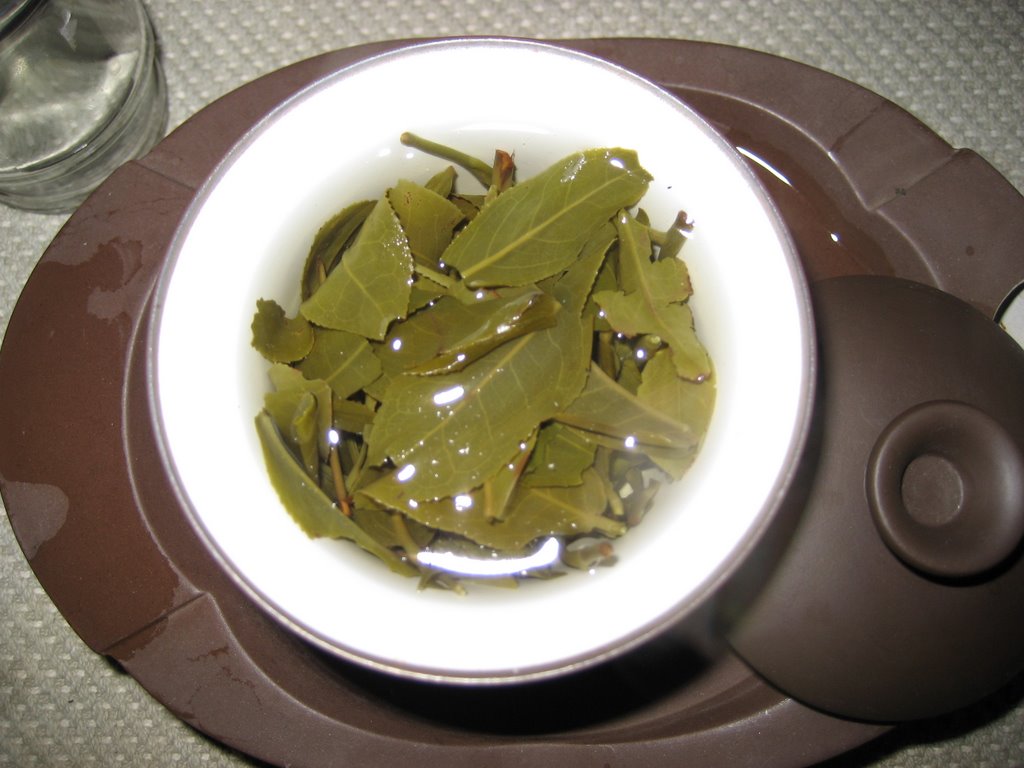
Green Tea 2009


Green tea is a rare visitor in my tea life. Once in a long while I drink one voluntary. For the past week on the other hand, I have been drinking a green tea 5 days out of 7. It is more than the total number of greens I'd have in a year.

After 2 years of sleep in a plastic bag, a sunbath for a week gave it a whole different life. Reroasting is not an option since it takes 3 months to mellow out the fire. Sun radiation, especially the hot scorching sun of California does the trick. The green color may turn yellow, the fresh aroma may be disappeared, but it takes on a whole different complexity in texture, mellow, smooth, rich minus the grassy taste.

Thursday, December 16, 2010

Hand twisted and machine pressed Tai Ping Hou Hui

Huang Shan - Yellow Mountain is notorious for sun rise and teas reside here. Sun rise of Huang Shan is ranked number 1 in the world, follow by Egypt, Norway and Ali Shan of Taiwan. The reason for that is the sea of clouds where the sun arises. That means the location has what tea trees want to shrive!

Tai Ping county is nested in Huang Shan, local soil is deep and rich before reaching the granite layer, decomposed granite allows water to sip through and provides rich minerals that nourishes plants and give tea trees its unique regional flavor.
While attending a tea research meeting in An Hui province, hunting for Tai Ping Hou Hui is on top of wishlist, it's I admit my top choice when it comes to green tea. Hence I spend the time to hunt for the right source and learn about it. Here are 2 TPHHs for learning purpose:

Hand twisted from Hou Keng, Spring harvest, leaves are not uniformed, darker in color


Machine pressed also from Hou Keng, Fall harvest, leaves are uniformed, lighter green in color

Flavor of the two are rather different, Spring harvest is rich, sweet, smooth, and very aromatic, aromatic and sweet after taste. Fall is aromatic, can be bitter if over heated and over steeped, however after taste is sweet and lingering, not as smooth as the hand twisted one for 2 reasons: Fall leaves and machine pressed. Stems and partial leave tissues are broken which cause the bitterness and rough texture.

Wednesday, September 29, 2010

Competition green teas

To anticipate in the first open tea championship by the International Tea Expo, Tea Habitat hand selected a few teas to compete in the Pan Fried Green Tea category a couple of months ago. Oolong competition is held in February next year.

I am greatly disappointed for a number of reasons which I can't bring up openly. The result is the cause of disappointment, but not the origin.

Jade tip is one of the more than 250 teas under the same category which entered the championship. Highest score is 89 out of 100, second place is 88, third is 87, Tea Habitat's Jade Tip got a 84 rating. Another green tea we entered is Three Cups Fragrance which got a 83 rating.

Let's take a look of the leaves of Jade Tip...
Grown in mountains of 700 meters above sea level in Zhe Jiang Province. Spring tips of 2010 harvest, some of the best and very limited production of green tea. Absolutely excellent quality!
$63/125 g, only 375g available, Price is sold at cost.


Three Cups Fragrance....
Also grown in the same altitude of 700 meters above sea level in Zhe Jiang Province. Three Cups Fragrance is a varietal only local to this region--Tai Shun county. I personally slightly bias toward this tea compared to Jade Tip in terms of flavor, thickness and intensity of texture, although the look is less uniform than Jade Tip.
$54/125 g, 375 g available, Price is sold at cost.

2nd place winner by another company, will include a sample with purchase of above teas.

Wednesday, April 08, 2009

3 teas for the day

It's been a long time since I have done a tea evaluation tasting with pictures and notes. When you get swamped by many teas at one time, it's overwhelming to conduct such in dept tasting while entertaining clients.

Three teas on the menu today:
1) 1994 Green Tea
2) 2005 Wu Dong Dan Cong Cha Tou
3) 1986 Honey Orchid Dan Cong

1994 Green Tea:
A classic sample of well roasted tea using charcoal as a heating source. If you are not quite sure what charcoal can do to a tea, this is a profiling tea to have. In order to store and age tea-any tea, the bottom line is low moisture content. If you got that down, any tea can be stored for years. The oldest I have heard and still drinkable (no one died from drinking it) is about 800 years old, buried under the ocean floor for 99.9% of its life time. Believe it or not, it's a powdered green tea brick wrapped in sealed wax paper.

The flavor of this aged green tea comes from transformation of substance via roasting and aging. The color is a glowing clear light amber hue. Sweet with black tea like texture, a sweet dates like flavor which present in charcoal roasted teas. You can not detect any green tea shadow in this tea until everything goes down. After taste clearly unveil the crisp unfermented mouth feel of green teas.

Since this is green tea, using green tea brewing parameters is essential, although slightly higher temperature (95 c) water can bring out the charcoal flavor more than cooler temperature (87 C). Boiling water is not recommended. Some how the sweetness and flavor are trapped inside of the leaves when using boiling water.

Tuesday, January 30, 2007

Green day

Part of my loose leaves order arrived over the weekend. Inside of this box are mao fung, silver needle, sun dried bai mu dan, traditional bai mu dan and 10 kg of Lao Ban Zhang.

Sun Dried Bai Mu Dan

This is my favorite out of the 4 greens. Although I am not a big fan of green, this Bai Mu Dan has the floral aroma of a dan cong, sweetness of a pu-erh and the lightness of a green without the bitterness and grassiness.

4g, gaiwan, crab eye water, bottom throw
It started with a strong sweet floral aroma, liquid is clear yellow, sweet, a lot of flavor for a green. Being sun dried, it should be categorized as white instead of green?! Well, it has all the characteristics of white, no much of green at all. It can take long steeping and hot or warm water, taste great hot or warm. The flavor does not turn bland in anyway. It's a great tea for beginners and every day office drink. You can't make a bad cuppa with this tea no matter what tool you use. Well with the exception of bad tap water maybe. Love it! A good skilless tea.
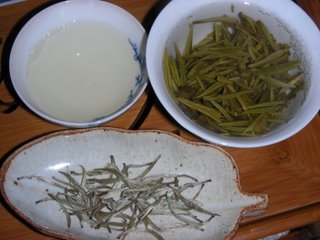

Silver needles

Attractive looking leaves, young and hairy, though not as hairy as some others I have seen. It's also on the thin side.

4g, gaiwan, crab eye, bottom throw
It was nutty and grassy, astringent, very light yellowish color, sweet after taste, dry mouth feel afterwards, can't take long infusions. It's decent, but nothing to brag about.


Jade pole
interesting looking tea, my first perception was these might be some old leaves. Turns out they are very young and tender, long thin leaves picked right after spring rain.

4 poles (4g), gaiwan, crab eye, bottom throw
Sweet and nutty, a bit astringent, slight sweetness, last 3 brews, faded quickly after the second. Its flavor is better than the silver needles.

I had 3 out of 4 greens so far for the day, and already drunk. But, I am going to hit one more - traditional bai mu dan.
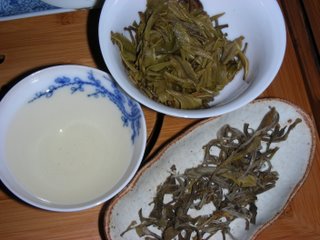

Traditional bai mu dan

This is a true green version, steamed then dried.

4g, gaiwan, crab eye, bottom throw
Light floral, grassy, hint of nutty and astringency, sweet and nutty after taste, last 3 brews, mild in every way as a typical green. Bitter and astringent when steeped for long.
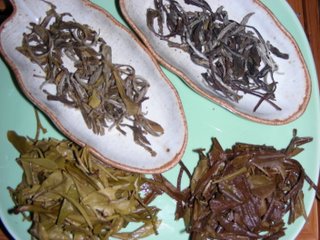

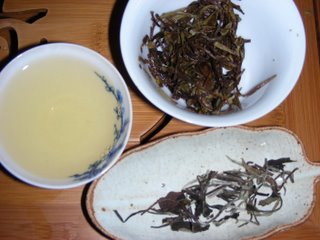
Difference of the 2 bai mu dan

Left: traditional (steamed green); right: sun dried (fermented during drying). Sun dried version is very flavorful compared to the steamed version. The fermentation allowed the break down of the sugar, gave it a honey like sweetness brew after brew. This is my re-orderable item.

Monday, October 09, 2006

Taiwan Lung Jing


It's been a while since I got this Taiwan Lung Jing sample from "Old Brand". I finally have the time to sit down and try this tea.

Taiwan Lung Jing is different from the Zhe Jiang Lung Jing from Mainland in many ways. 1st is the tree varietal, 2nd is the size and shape of leaves, 3rd is the taste of course. Taiwan Lung Jing was an imitation of the Mainland LJ, when the army of early ROC moved onto the island, nostalgia was spread among soldiers after the migration, one of the most memorable item was LJ. Taiwan LJ was evolved from a local green varietal to meet the demand of immigrants.

2g, crab eye water, gaiwan
Dry leaves: Long, thin, green to dark green, some white hair covered leaves, various length, sign of broken leaves, ripen fruity aroma, hint of smoky

1st brew: after preheating gaiwan, filled up 1/5 of gaiwan, then added in tea leaves, let soak for 20s, then filled up to top with raising the water kettle in order to cool off the water a bid, 45s. Sweet taste like dried Guei Yuen (a dried fruit similar to LiChi), smooth and clear, light amber yellow color

2nd brew: filled crab eye from side of gaiwan, steeped for 1 min, more yellow, hint of astringency, less sweet, not much aroma, getting weak

3rd brew: 2 min, yellow, astringent, over cooked tea taste, flat

Over all, a very light tea, good for a single brew, not bad but nothing impressive either.

Wednesday, August 30, 2006

Unknown age Lung Jing from HangZhou, China


Unknown age Lung Jing from HangZhou, China. I was at my parent's house last weekend, as usual, I look through the cabinets and pantry to find more tea. My father is a tea drinker although not as crazy as I am. There are at least 15 kinds of tea remain unopened at my own home, and I am looking for more at tea shops and my father's reserves.

Quantity: 20 leaves, hot water (shrimp eyes) in gaiwan (100ml)

Dry leaves: earthy greenish brown, uniformed, aged aroma unlike fresh green smelling Lung Jing

1st brew: light yellowish color, slight smoky aroma, a bit green grassy taste, smooth, sign of aging in taste and color

2nd brew with boiling water: more yellow than the first brew, clean smooth texture, indescribable light aroma, it can take the boiling temperature quite well, no bitterness or astringency

3rd brew: I added a few blooms of the tea tree flowers, the aged LJ came back to live with honey roasted aroma. I am really digging these flowers!

Opened leaves: it's actually greener! mixture of leave types, one tip, or 1-2 leaves and a tip, good but not the best grade

This should be one of those tea for drinking in the office, make a quick cup, it's not bad but doesn't require "high maintenance" type. Lung Jing is not my favorite choice, I guess it's not one of my father's either. It seems to be aged for at least a year to two.

Thursday, August 03, 2006

Jasmine tea


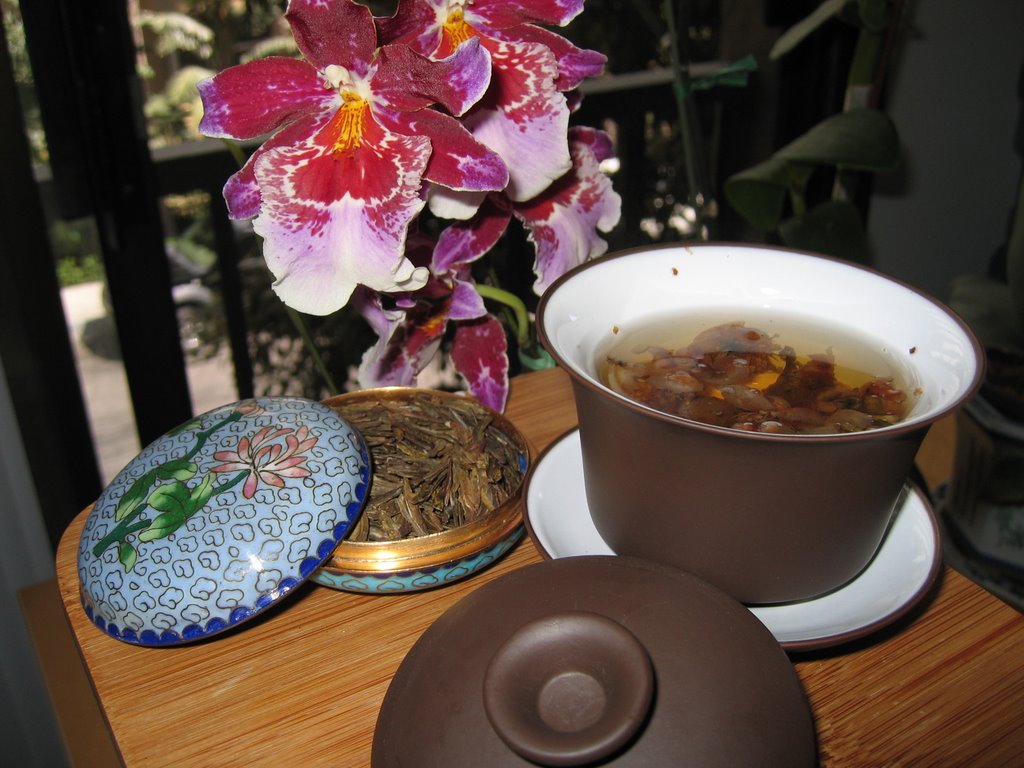
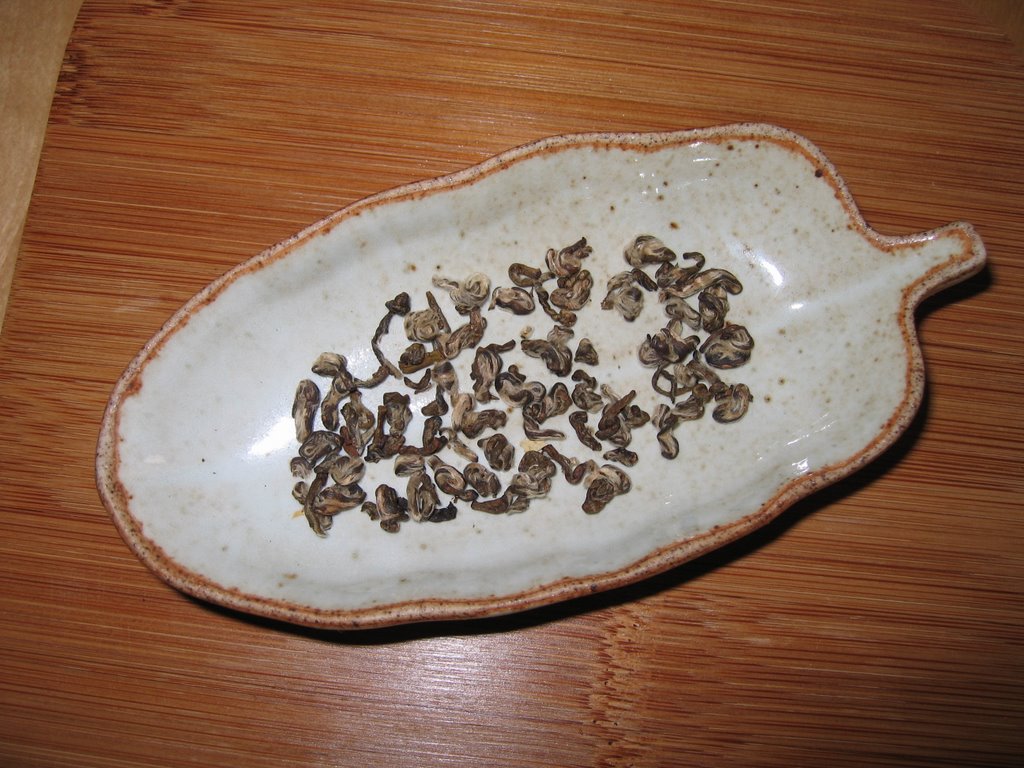
Jasmine tea - there are many varieties of jasmine tea, from china and Taiwan. Common ones from China are in dragon pearl (3 or 4 leave tips rolled into a ball), twisted knots or dragon fly (single leave tip in knotted or dragon fly shape), and small pearl forms (single leave tip rolled into small pellet). Taiwan on the other hand is loose leaves of green tea mixed with jasmine buds. The lowest grade (dim sum) of jasmine from China is also processed the same way as Taiwan. There is an overwhelming demand for jasmine tea in the west. Methods of processing of jasmine tea have also been altered to meet the demand with competitive price. Dragon pearl jasmine tea are commonly scented with artificial flavor. Tea leaves has an amazing absorbing property which made it possible to add floral fragrance for flavoring enhancement. Traditional process of jasmine tea is long and tedious. When green tip tea is picked and processed into dry readily drinkable tea, fresh jasmine flower buds are wrapped in cloth bags, placed in container containing dried tea leaves, sealed for over night, allowing the leaves to absorb the moisture full of jasmine fragrance. The flowers are then taken out next day, tea leaves are baked lightly to allow moistures to evaporate. New batch of fresh jasmine flowers are placed in sealed container along with tea leaves again for another night of absorption. This process repeats 7 to 10 days for maximum flavoring.

The difference in taste is rather noticeable. In dry form, artificial flavored jasmine tea associates with a sharp perfume like smell, rather intense and pungent. The naturally infused jasmine tea, on contrary, has a mellow, mild lingering aroma which is very refreshing with a hint of sweetness in the air. The former tea taste also has a sharp chemical flavor, while the later is smooth and sweet, subtle fragrance of jasmine flows above puff by puff. The former will lose the aroma quick after the first brew, while the later can last 3 or more brews. I saved a small amount of a small pearl jasmine tea I came across in Harbin, China 8 years ago. The fragrance still lingers today without a staled smell. Wonderful tea! See picture.