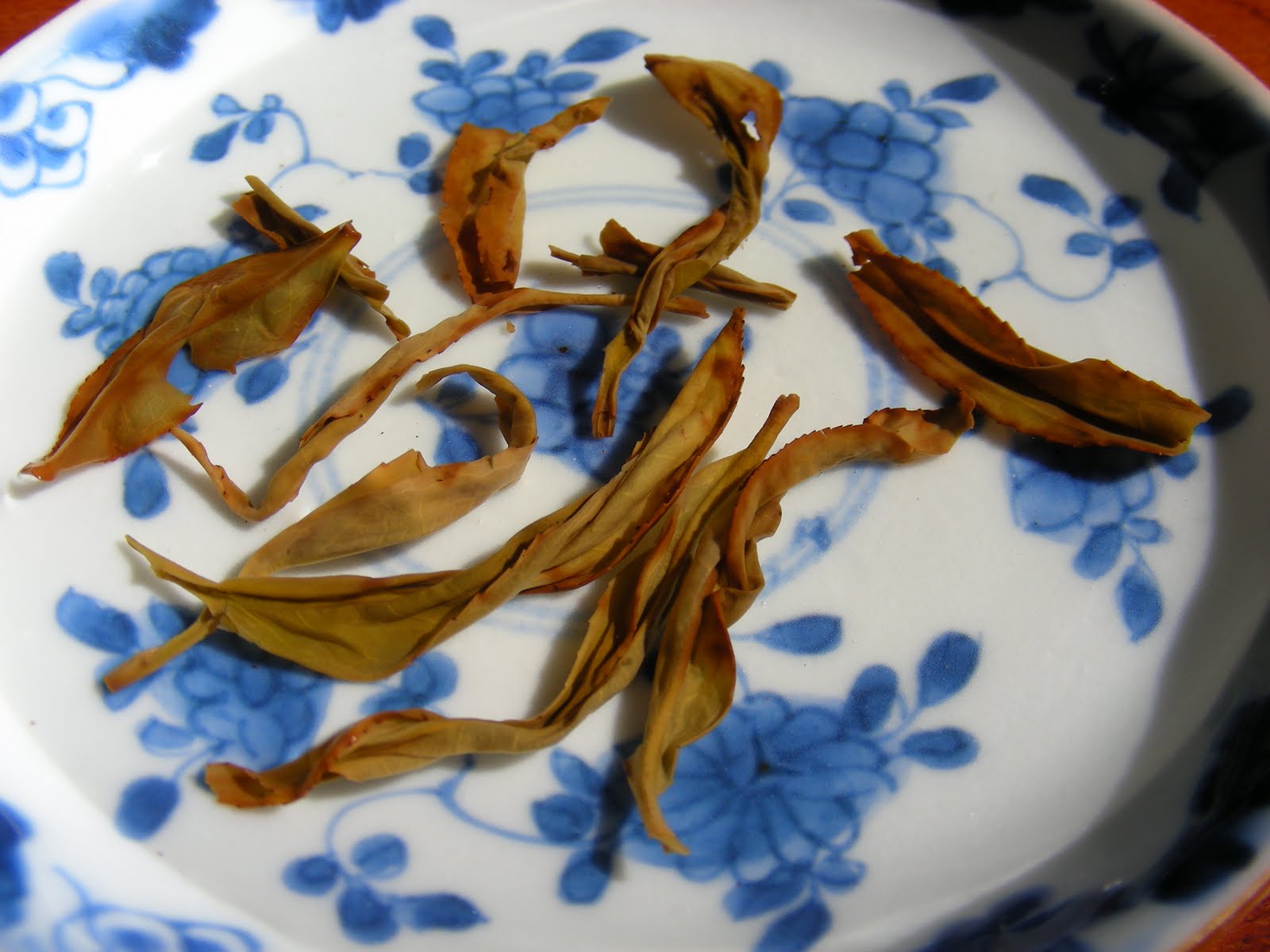
After loosing sleep for a day from tea drunk, here is a list of this years stock at Tea Habitat. Description is never my strength, so some what brief. I will update them periodically when I drink more sessions of them and if I would be inspired with better terms. :)
Wednesday, July 11, 2012
2012 Phoenix Dan Cong Oolong in stock
After loosing sleep for a day from tea drunk, here is a list of this years stock at Tea Habitat. Description is never my strength, so some what brief. I will update them periodically when I drink more sessions of them and if I would be inspired with better terms. :)
Saturday, February 11, 2012
Teas I am drinking today

Having a cup of 2009 Gui Hua Xiang- osmanthus flower fragrance Dan Cong Oolong next to my valentine's gift from a friend, a white with slight pink trim dandrobium orchid. White orchids have the most clean, pure and magnetic fragrance compare to the same specie of a different color. I also find that is true for other flowers as well. Pure white rose smells more pure while a red rose has a sweeter and stronger aroma.
Being busy with cupping 2011 teas repeatedly, I forget some of the older teas although I know they can't be bad after a couple of years. The rich honey characteristic must be easy to detect compare to new crops. Bo Jai Ye is also very nice now, deep and rich.
Wednesday, December 07, 2011
Surprisingly lovely pomelo flower fragrance tea
Water is boiling in a non-whistle kettle on the stove, tumbling bamboo charcoal noise is the tell tail. Quite morning with sound of percussion, instantly warms the air.
A random pick out of a pile of teas, what a surprise to find such smooth sweet leaves. 2011 You Hua Xiang - Pomelo Flower Fragrance. What time can do to mellow down a tea, so to human~ I shall put in on the recommended list of Dan Cong oolong teas.
Tuesday, November 01, 2011
Today's Dan Cong Tea Cupping - Second Round
Fall~is the season of Dan Cong Oolong. High mountain old single tree Dan Cong completed processing between May and June, after a 3 months rest, fire flavor subsided, true flavor finally reveals. Starting mid to late September, most DC teas should taste smoother than it was a few months back. Well, I know it's November now, I know I got a little lazy...
Today, is the beginning of another round of re-cupping the inventory. 3 teas I had and still drinking are: Gu Shu Lao Cong - Ancient tree old bush (sounds redundant eh), Gong Xiang - Tribute Fragrance, Rou Gui Xiang - Cinnamon Aroma.
Gong Xiang - Tribute Fragrance is getting better and better, it was very nice when it arrived, almost flawless compare to others of the same year harvest. The fragrance is beautiful as it should be. It's my very favorite then, and still is one of my favorites.
Rou Gui Xiang - Cinnamon Aroma, don't mix up with Wuyi Rou Gui Rock tea. They are two completely different teas in terms of origin, varietal, process, style, flavor and aroma. I remember during the first round of cupping, the flavor is unique and sharp. Today's impress is much improved! It has a minty cool after taste that last, smooth like butter, try brushing your teeth left and right with tip of your tongue, I think ice skating is about as smooth as I can imagine. :P The flavor is more pronounced than most of the sweet floral Dan Cong teas, masculine may I say. The kind of cinnamon as if you break a small piece of a cinnamon bark, place it in your mouth and let the saliva slowly extract the sweetness, spiciness off, not overwhelming as apple pie.
Wednesday, July 27, 2011
Gong Mi Lan - Tribute Honey Orchid 2011
A hot day today in South Cal, although I shouldn't complain compared to the inland with a 20 degrees cooler temperature and sea breeze. Hot tea as usual, if you call me crazy.With the new 2011 Dan Cong tea arrival, tasting each tea with various methods and multiple times is a huge task. After all drinking more than half a dozen a day is excessive to my taste buds. The first round of cupping was done in gaiwan for 5 minutes, the basic tasting notes were based on that.
Today's method is gaiwan gongfu style with Bai Ye Gong Mi Lan - White leaf tribute honey orchid. Honey orchid is the most reliable tea out of all, it's straight forward, present, good flavor, easy to brew, no down time waiting period, no disappointment each and every time year after year. Out of almost 20 new teas arrived, this is one of the most ready to drink teas.Upon opening the bag of Gong Mi Lan, a strong passion fruit, lichi, ripe peach aroma you can't unnoticed. It's much stronger than others without anything added.
A sweeter lichi and peach aroma can be smelled as soon as the water is add, flavor is just as it smelled, after taste has a little like mango. Each infusion is slightly different varying from fruit to fruit in mixed combination. Complex, soft, interesting and pleasing. The signature honey sweetness and fullness last many infusions. A tea does not require a lot of attention to enjoy the wholeness within.
Wet leaves are still semi rolled up and thin at the end of the session, signs of high altitude from old trees due to slow growth rate of aged trees in cooler climate covered with clouds. Meaty leaf is not a good sign, either located at low altitude hot temperature environment and or fed with fertilizer.Aroma: 5
Flavor: 5
Texture: 4.5
After Taste: 4.5
Over All: 4.75
Tuesday, July 26, 2011
Honey Preserved Dan Cong Oolong Tea
Home remedy is widely used and relied on by many villagers of the remote mountain, even today's modern medicine is readily available. Phoenix mountain residents keep aged teas for minor colds, coughs, fevers, stomachaches of the like. Aside of the dried method of aging tea, honey preserved tea is also a popular regional treasure. Honey from local hives and Dan Cong tea combined together is not only a tasty drink, but also medicinal.High grade raw honey, glass jar preferred, and good Dan Cong teas, simple as fill the jar with dry tea leaves, then add honey to top, seal and let it sit for a week before consuming. However the longer it is put away, the better the medicinal effect it has, years, 10, 20, 30 years. One word of advise, if you plan on keeping it for a long period, good tea and good honey is a must. After all, the time you invest in is more worthy of the ingredients. I don't think you want to wait 10 years for something mediocre.
Raw honey is relative hard to find in the states because FDA require honey sold in the states must contain less than a certain percentage of moisture. Hence, most available commercial honey are heat treated to reduce moisture, therefore losing many nutritious contents such as enzymes and vitamins. Also runny but not watery honey is necessary, crystallized honey contains impurity as well which is less desirable. Spring honey and Winter honey also have different benefits. Drink Spring honey in Spring, Winter honey in Winter to counter seasonal sickness is suggested by Chinese medicine. For example, Spring honey has detoxing benefit due to bacteria/virus spread in Spring, Winter honey has lung nourishing benefit due to dryness in Winter .
Tea selection needless to say the better the tea, the better the result. Good tea does not necessary have to be tasty tea. Good tea is naturally rich with substance which can be visible and detected in texture. A rich tea is round, thick, creamy, smooth or buttery, while all these are present does not necessary make this tea tasty automatically, but in most case it is. Tasty or not in flavor is also subjective by each drinker.
My first choice of tea to be preserved is Hong Yin, since I will invest a LONG period of time, I choose 1978 Wild Hong Yin. In 20 years I'll have a jar of 53 years old honey tea. :D Hong Yin is also very rich in texture compared to other Dan Congs, there isn't much aroma, hence would not be overwhelmed by the floral aroma of raw honey. The other choice was a tea from a 220 years old Dan Cong tree. It also has a rich texture that is savory in taste, but aroma is less appeal than other floral Dan Cong teas. Will try the second one in a week, then a few months, a year and so on to see the difference in evolution.


Friday, July 15, 2011
Flourish
Lao Xian Yong-Phoenix Dan Cong Oolong Tea, a moment I shall remember....With this year's good harvest, it's to be celebrated with a few private selections of my own. Have I had a tea only to bloom after it disappeared in form of liquid? It's a new life experience with tea for me. Not a sign of impression in searching for that typical aroma, flavor when I drank it. A tea without a head turn so I mentally noted it at first. As the cup was released from my fingers, carelessly put down on the kitchen counter, heading to flip the next page of Li Qing Zhao - one and only famous female poet of the Song Dynasty. The most delicate aroma began to open up in my mouth, the flowers in her poem came to alive as it appeared. The fragrance occupied all my senses through my nose drifted well beyond one's mind. Let it be, let it be! Let it permeate~ Let it linger~
Li Qing Zhao is famous for her love poems. She had a loving marriage but short lived. Living apart with her husband and soon passed away, her sorrows were painted on her words with Spring blooms and withering willows.
A poem can strike a soul, a tea can nourish one, I am in the mood for love-a song compliments the two.
http://www.tudou.com/programs/view/Qaew_aORpZk/
Sunday, August 29, 2010
Dat mythical tree

I heard of it, I talked about it, I got my palate around it this morning!
Jiang Mu Xiang! Ginger Mother Fragrance --- sold for 60,000RMB per 500 g this year, almost $10,000.
Yesterday my Korean friend called me up in the morning, interested me in going to the Fowler museum at UCLA. A temporary exhibition of Koran potteries by 5 contemporary artists and burial figures from the 19th century is currently held at Fowler. I jokingly said to my friend, let's take a pottery making class afterward.
Three other exhibitions are held at the same time. Textile making from Indonesia, Masks and other ritual figures from mostly Africa, south America and southeast Asia, silver ware of the 1800's and 1900's from England. I found 3 eye catching silver cloisonne pieces made by Russian silversmiths in the mid to late 1800's.


Upon returning to home, I found a package from China. Although I have expected its arrival for a week, but knowing the content of this package, excitement can't be subsided.
After a busy yesterday, I was not ready to drink this tea last night. As I woke up in the morning, taking the time to prepare at a spot where I can pay full attention to my tea, a cup of Jing Mu Xiang is rewarding.
The color is unusually light, and deceiving. As I took a sip, a tingling ginger spice sensation can be felt on the first half of my tongue, it lingers for a long while, even as I am typing at this moment. It's not floral fragrant as many other Dan Cong oolong, although subtly fragrant. The money is all on the after taste and sensation. It's so thick, almost pasty as I sip it. A layer of buttery film coats my mouth for a long time. Without breakfast, my system is clean to take in the effect of this tea, and sure enough, I feel bloated after only 3 little cups, as I just had a meal. My eye balls are popping out right now!
Along with a small 10g sample of Jiang Mu Xiang, Tian Yi Xiang-Heavenly Leisure Fragrance, 08 Chuan Du Lao Ming Cong---the very first old bush Dan Cong that knock me off my socks in 07 and has since made me an addict, rather spend all my savings on tea rather than buying clothes and purses, devilicious fairy of tea tree! There are more of the 05 Ba Da wild Pu cake came with the Dan Congs.
Friday, April 02, 2010
Today's tea - Kan Tou

Kan Tou Old Bush Dan Cong Oolong, means edge of retaining wall, gained its name due to its location. It is a confusing name since most of high mountain DC's were grown on hill side with retaining walls everywhere. Well, out of that many, only this one marked its territory in name of history, and for good reason!
For almost a month, today is the first time I spend time to observe tea whole hearted. I choose Kan Tou out a few that I have not posed on website out of procrastination. There are a few trees I got after last year's China trip.
Fragrance is between Orange flower and Pomelo flower, lighter than orange flower, and stronger than pomelo flower. The fragrance is mostly in the taste lingers on every surface of mouth, warmth of tea soothes every inch of through as the liquid traces down, embracing with nectar of nature - sweet and floral. It's been more than a month since I had this tea, procrastination is not to be praised.
For some reason, I like spending time to learn about a new tree before posting it. 3 to 5 times over the period of months is not a long time to learn about a new subject, person, job, place, so is a tea. Kan Tou is definitely one of the teas on top of my list now.
My new year resolution is to be more diligent, especially on tea reviews. :P
Friday, January 08, 2010
Tea review - Jan 2010
Yang Mei Ye: got its name from the shape of the leaf when fresh. Here is a picture of the tea after 20+ infusions. Good looking leaves, thin large leaves, very soft and flexible, mixture of open leaves and still rolled up younger leaves, a sign of aroma with Yun both present in this tea.
Taste is sweet with a hint of plum wine flavor, with long lasting sweet after taste concentrating on the throat. It can last up to 20 some infusions. The Yun is what I love about this tea the most.

2003 Liu Bao Flower Buds. Yunnan open flower teas are quite easy to find, however Liu Bao flower buds only tea is not so common. These are all unopen smally flower buds that have been stored away for 6 years. The initial flavor is clean and sweet, the fragrace become stronger as the number of brews increases. Some times I forgot about it and left it brewing for a long time and cold, the fragrance is so delicately strong as it's blooming right in the mouth. Very lovely tea!
As my tea age increases, the more I look for in the substance of the tea. The Chinese name this substance Yun. It's how the tea make you feel, sweet, rich, smooth, stay in throat centering by the neck. The richer the Yun (substance) a tea has, the lower it reaches down your pipe. Tasty teas stay mostly in your mouth, good teas stay in the back of the throat, better teas travels down the neck, excellent teas reaches the chest, the best tea I ever had got all the way down to my heart.*** to be continue with more tea reviews
Monday, January 04, 2010
Thursday, December 17, 2009
Free Dan Cong oolong tea if you can proof me wrong
I have been selling single bush teas for almost 3 years. From what I gathered online, most tea drinkers find them better in quality regardless of price. However, there are still speculation on whether I am misinforming tea lovers about the true single tree batch. Or rather the concept/practice of single tree process simply does not exist.
It's one thing to be skeptical, it's another thing to mislead others without knowing first hand information (the truth) but claim they are right. I would like to know the malicious intention of such people for telling lies. What could benefit them from denying the truth?!
I make it clear here: on my website, I separate the single processed teas from commercial mass produced teas in 2 different categories. The prices reflect the quality difference as well. I do not claim the commercial Dan Cong are single tree processed, they are NOT.
What bothers me the most is that some long time tea drinkers are misinforming others simply they have a group of blog followers whom will take their words as facts while they have never been to Chao Zhou, never been up on the Phoenix mountain, never have seen such tea made, never learn to brew them properly, never even tasted enough of such teas to make their own judgment. What backs up such judgment???? Some speculated reasons without proof? SHOW ME PROOF! That's all I am asking, not some made up "this is what I think" out of thin air because you have drank lotsa tea for a long time. Hearing something, searching online does not give you accurate information compare to historical documentations and real practice by the local professionals. See it with your own eyes can only be the truth. Until then, we should all be modest and learn from good source before we say something. Then again, the pity part is good sources are hard to find.
There are plenty of documents on historical single tree process practice off line. If you want to go further, go to Chao Zhou city hall, you'll find a "CHAO ZHOU ZHI" documenting all varietals and history up today since Qing Dynasty. While you are there, go up to the mountain and see it for yourself. I am not telling you what I say is right, I am telling you to find the truth yourself in reality (not from cyberland), at least proof me wrong with real evidence. I am sick and tired of such meaningless speculation, quoting misinformation from the internet back and forth time after time with the same bs from the same sources.
Here is my proposal, take your phoenix oolong teas to Tea Habitat, I'll match you with a tea, if you can proof my tea isn't high mountain single tree processed, I'll send you home with a pound of my single bush oolong. I can show you the difference between single processed old bush teas and commercial mass produced dan cong oolong teas while you are here. People can lie, but teas don't.
This is why we have to learn to identify good teas and not fooled by sellers or whoever tells you BS. As Xun Zi (author of The Art of War 3000 years ago) said, arm yourself with knowledge, know your own army (tea in this case), know your enemy (tea sellers/bloggers in this case), you win half the battle already.
It's unfortunate that some sellers do tell lies to make a sale, or simply don't know enough and had to make up stories. However, my question is does an iphone user know how the iphone is made? Using the device daily since day one, mastering all the buttons and functions does not make you an engineer that knows how to design and put together an iphone. Does a long time tea drinker know everything about how tea is made from every region??? I don't even think Yao Guo Qun would claim that. I have vented enough.
Wednesday, December 16, 2009
Phoenix Moumtain Pictures
Sunday, November 22, 2009
Passionate Tail Ant

Well, happiness has happened twice in just one weekend at Tea Habitat. The 2 love birds in the picture announced that they are getting married to their parents on Saturday. They made their announcement while drinking Passionate Tail Ant Dan Cong - Ni Wei Yi. We were all over joyed!
Today - Sunday, a young lady informed us she's getting married as well while drinking the same exact tea Passionate Tail Ant Dan Cong.
It's a SIGN!
Congratulations to all the lovers who are meant to be together! May happiness with each and everyone!
I will drink the Passionate Tail Ant tea fast! And I will reserve this tree till I die. Perhaps this is the tree calling for my ashes... hahaha...
Monday, September 14, 2009
What does Cong 丛 mean?
It's 单丛, not 单枞. The correct Chinese character has always been 单丛 used in Chao Zhou. Out side of Chao Zhou, it's aslo commonly seen as 单枞. Yes, even the Chinese in China-alot of them too misuses the character.
丛 (Cong2): bush, shrub, a cluster of branches grow from the same root as one single plant.
http://en.wiktionary.org/wiki/%E4%B8%9B
枞 (Cong1): Fir - Abies Firma
http://www.nciku.com/search/zh/detail/%E6%9E%9E/6423
The 2 characters have extremely different meanings with different sound/tone, mismatching doesn't even make sense. It's quite disturbing to see the Chinese misuse the character in China, hence misleading foreigners. You can even hear Chinese national TV hosts say 枞 (Cong1), emphasizing the incorrect pronunciation as correct. This problem perhaps can be corrected when over all education improves in a couple of generations if not longer. Tea farmers are mostly illiterate in China, great tea making skills but lack of eloquence. When China is open to private business again in the last 20 some years, a flood of misused characters can be seen everywhere, logos, signs, fliers, ads, menus, etc. English translations are even more hilarious during the Olympic games.
Dan Cong, literal translation is Single Bush, as a bush is a cluster of growth from ground up feeding off from the same root as one plant. In Chinese, a bush has no limit of height and size, unlike the English term, it's limited to a small short shrub. Hence, a tall tree with many large separate branches attached to the same roots is also call a bush (1 丛) as a unit of tree.
Cong is also loosely translated as trunk, grove, and some other meanings. While not entirely wrong, but not quite precise either.
Translation and interpretation from one language to another is never 1 = 1. As long as 1 = .9 is rather understandable. If someone claims 1 = -1, that wouldn't be so acceptable, eh?
Saturday, September 12, 2009
Continue to fight for Dan Cong
This is a book I am translating: Feng Huang Dan Cong. It does not have a gram of my opinion. If any one reads Chinese, please correct me if I were off on the translation.
Following is the exact same description of a tree name Song Zhong #2 in Chinese as in the hard copy of this book shown in picture. Below that is my translation word for word.

宋种二号
宋种二号,又名宋种仔单丛。系乌岽中心寅村的老宋茶大草棚单丛(1928年枯死)自然杂交的后代,故名。
生长在东经116°38′38″, 北纬23°58′19″坐西南向东北的山坡,海拔高度950米的凤凰大庵村村后的茶园里。该茶树自1660年~1952年为凤凰太平寺的固定财产。1952年土地改革时间,分配给贫农黄勇,1958年~1980年为大庵生产队集体所有,1980年起由黄娘庆管理,1988年~2000年由黄爱国管理,2001年至现在由黄保国管理。
该树系有性繁殖植株,树龄347年,树高5.56米,树姿开张,树冠5.6×6.5米,主干因客土后不明显,接近地面有六大分桠,分枝密度中等。叶片上斜状着生,叶形长椭圆,叶长7.8厘米,宽3.7厘米,叶面平滑,叶色深绿有光泽,叶质中等,叶身平展,叶脉9对,叶尖钝尖,叶缘微波状,有24对细、浅、钝的叶齿。育芽能力较强。春芽萌发在春分,春茶采摘期在谷雨后,发芽密度较密,芽色浅绿,有少量茸毛。新梢长12厘米,着生片数3—4片,节间长3厘米,每年新梢生长2轮次,10月起为新梢休止期。盛花期11月中旬,花冠直径3.2~3.8厘米,花丝120~130枚,柱头分3叉,果实多为2籽。2007年春茶产量13.2市斤,每市斤6000元。2008年春茶产量11.2市斤, 每市斤6500元。
Song Zhong #2 – Song Varietal #2
Song Zhong #2 is also called Song Zhong Jai Dan Cong – Little Song Zhong. It’s propagated from a natural hybridized seed of Song Cha Da Ciao Peng Dan Cong - Big Thatched Shed, hence the name Little Song Zhong. Song Cha Da Ciao Peng died in 1928.
Located at 116°38′38″ longitude, 23°58′19″ latitude on a hillside facing northeast, 950 meters above sea level, in a tea garden behind Feng Huang Da An village. It was property of Feng Huang Tai Ping Temple from 1660-1952. During the Land Reform Movement in 1952, this tree was assigned to Mr. Huang Yong. It was then owned by Da An production team from 1958-1980. It’s under the care of Mr. Huang Nian Qing in 1980-1997, Mr. Huang Ai Guo from 1998-2000, Mr. Huang Bao Guo since 2001.
This tree is propagated sexually, age 347 years old, 5.56 meters tall, spread out tree body, tree crown is 5.6X6.5 meters, main trunk is not visible after additional soil, 6 split branches at ground, medium branch density. Leaves grow slanted upward, long oval shape, 7.8 centimeters in length, 3.7 centimeters in width, smooth surface, flat leaf body, shiny dark green, medium thickness, 9 sets leaf vein, round pointy leaf tip, slightly wavy leaf rim, 24 pairs small, shallow and blunt saw teeth. Sprout growth is strong, spring sprouting begins around Spring Equinox, picking begins 15 days later, dense new growth of light green color with small amount of white down. New growth is up to 12 centimeters long, 3 to 4 leaves on each stem separated by 3 centimeter. 2 new growths each year, stops growing at the beginning of October. Blooming season is in mid November, 3.2-3.8 centimeters in flower diameter, 120-130 stamens, 3 heads stigma, 2 seeds in each pod. It produced 6.6 kilograms of tea in 2007, sold for 12000 RMB per kilograms. Produced 5.6 kilograms of tea in 2008, sold for 13000 RMB per kilograms.
*2 市斤 = 1 kilo
I am not trying to be righteous. But this is getting out of hand and too many people are getting involved, some are even from over seas. The authenticity of Dan Cong, reputation of Chao Zhou people and mine are on the line, I am going to bust out a direct source of the Feng Huang Dan Cong book for Roy Fong to contact, Mr. Yao Guo Kun. Mr. Yao Guo Kun is currently the head of Chinese International Tea Culture Research Institute - Academic Department, also vice head of Zhe Jian Forestry Institute - Tea Culture Department.
Roy's comment: I am sorry that this has become so heated, and yes I do read Chinese. The fact that we are talking about documentation in books should stop us from arguing this further. What works in theory doesn't work so well in practice. I am not saying that no one ever made tea from one bush, but to have enough for commercial sales is simply not practical. A picture of someone picking tea from a tree is a far cry from actually producing tea. Perhaps someday you and I can be on a tea farm together to witness the actual production of 5 kilos of finished tea from one bush...
In response to Roy's comment:
I don't understand why is it so hard for Roy to believe such practice exist in the old days and today. This book is published this year, written by some one has 25 years of Dan Cong growing and producing experience, plus a masters degree in Tea Biology currently teaching at a University on subject of tea cultivation. If that does not make his THEORY (as Roy calls it) practical and REAL, I have nothing else to say. Let me clear it again, we are talking about small individual tree production, not mass quantity production as in a run of the mill tea farm. What is enough for what quantity production must be clarified. I am not saying a tree will produce enough for the mass population with thousands kilos of tea, a few pounds is a very reasonable and producible amount from one tree. This is not considered as commercial production, it's ALTRA RARE (borrowed term from ITC) also sold in markets. This is not even a secret! Why is it so hard for a man to admit he's wrong!
Please do not disqualify others with less than 20 years of tea business experience to take on this debate. Discrediting documentations all together is not a way to update tea knowledge in my opinion, combined with taking for granted of one's long term working experience. It's sad to find such mentality in any industry. Theory alone is not enough, experience without theory can only take you so far as well. From Roy's contacts' response, China is as misinformed or not informed as people in the US. It's understandable that one region's tea producers do not know about another region's tea. Asking a Yunnan Pu-erh producer about Dan Cong is like asking a Mexican to cook French cuisine, isn't it? The most reliable source of correct information is from the people grow those trees and make them into tea with their own bare hands.
I am willing to take anyone who's interested in witnessing tea produced from a single tree to Chao Zhou next Spring, Roy is more than welcome!
Thursday, September 10, 2009
Who's mistaking?!
http://camelliasinensisblog.blogspot.com/2009/09/clearing-up-common-mistake-what-dan.html
Let's get to the point here.
Quote: Actually, while dan cong (单丛) literally means "single bush," it doesn't refer to how the tea was picked. It's a botanical term relating to the morphology of the tea bush. While most tea bushes emerge from the ground in a cluster of branches, the uncommon dan cong variety emerges as a single trunk that branches off higher up the stem.
From what I am reading here, the writer said Dan Cong is a single trunk tree that branches off higher up the stem, therefore Dan Cong is named as Single (trunk) tree/bush which has nothing to do with how it's processed. But most of the tea bushes (excluding DC) emerge from the ground in a cluster of branches, therefore not called single (trunk) tree/bush.
Some one found this online about Phoenix DC in Chinese:
http://www.hudong.com/wiki/%E5%87%A4%E5%87%B0%E5%8D%95%E4%B8%9B%E8%8C%B6
Quote: 凤凰单丛茶属乌龙茶类,始创于明代,以产自潮安县凤凰镇乌岽山,并经单株(丛)采收、单株(丛)加工而得名。
Translation: Phoenix Dan Cong is catagorized as Oolong tea, development began in Ming Dynasty, produced in Chao An County, Phoenix Town, Wu Dong Mountain, gained its name Dan Cong (single bush) based on harvested and processed single bush/tree/plant indivdually.
Development of Dan Cong teas in modern days: http://tea-obsession.blogspot.com/2007/09/phoenix-dan-cong-is-oolong-tea-has-long.html
Let's see some pictures here:
Zhi Lan Xiang - local name is Ji Long Han - Chicken Cage, 7 branches from the ground up (click on picture for larger image). 4.87 meters tall, tree crown is 5x2.1 meters, produced 4.65 kilo of tea (finished product) in 2007 Spring, 5.5 kilos in 2008.

Mi Lan Xiang - Honey orchid, 8 branches from ground up.
Rou Gui Xiang - Cinnamon Aroma, 1 main trunk, 2 split branches at 0.56 meters above ground, annual production is 5 kilos tea (finished product).
In fact, majority of the Dan Cong tea trees/bushes are branched off from the ground up, rarely a single trunk as the Rou Gui Xiang tree in above picture.Quote: Unfortunately, tea sellers who have never visited tea farms and don't know tea all the way from the farm to the cup have misinterpreted the literal meaning of the Chinese characters and spread misinformation about dan cong tea. These inaccuracies have quickly propagated via the internet. If you've ever been to a tea farm or seen tea bushes out in the wild, you know that with a typical ratio of 8-10 kilos of fresh tea leaves required to make a kilo of tea, there's no way a single bush could generate a marketable quantity of tea, even if you killed it by stripping off virtually every leaf!
Let's say the writer has visited the farms in Phoenix Mountain. Does that mean commercial products are all there is to this tea region? If so the writer had visited region and had not seen the old bushes and tasted the teas processed single tree at a time, mostly grown amongst homes and not in a FARM, that just means he hadn't seem much of the hills. If this is all the writer learn about this tea at the mountain of Phoenix, he is the one should spend more time learning the truth before spreading inaccuracies which might quickly propagate via the internet.
A tree at height of 5.8 meters, covering 6.5x6.8 meters area produces barely 9 kilos of tea does require 35 kilos of fresh leaves. My suggestion is for the writer to find a tree (any tree) of similar size as mentioned, strip the damn tree naked and see how many kilos of fresh leaves (dried leaves on the ground does not count) can be collected. I am so darn curious to find out the out come.
Speaking of Dan Cong oolong only here: average production per single tree is 1.5 kilos, with the ratio of 35 to 9, each tree produces 6 kilos of collectible fresh leaves suitable for tea making per year, excluding older leaves. Growing up in the midwest, I had done some yard work of raking fallen leaves. I guess that will never happen to someone lives in San Francisco. Let me tell you, even fallen dried leaves of a tree in size of the above mentioned tree, that's a hell lot of work and bags of them each fall.
Marketable quantity is what? Mass production is what's available on the market, accessible to the mass population. Small 1 lb quantity is not mass production that's available in a niche market (at one store only). If large quantity is your game, that also speaks the quality of the business run by such mentality and that's find with me. The mass population have no problem with it, nor do I.
I hope the lesson we learn here, including myself, when we post something online, we are responsible for what we say, not just the self believing "truth" when it comes to the principles of facts. Especially when someone out there believe what you say. It's funny to tell a joke or stretch the truth. However when it comes to claiming the authority of the truth, please be well informed with proof then say so. Selling tea for many years makes one a businessman with some knowledge, brewing knowledge at best, definitely not the authority in production and cultivation! Learning the back ground and history of a tea is fairly important, get that straight before "My words are golden because I said so".
Wednesday, July 22, 2009
That's something to brag about
I got a big box of surprise yesterday! 9 Zhou Yi (I-Ching) books, 2 large bags of Song Zhong #5 and a box of Dan Cong tea samples. This box of tea samples are signature single bush Dan Cong teas in the Phoenix Mountain tops, designed to complement the book. They are composed with special trees introduced in the book of FengHuang DanCong Oolong Tea. It's as near as one can get to the trees you are sipping while looking at pictures of them in the book. Faaaabulous!I carry 13 out of 20 from this list of trees. I think my tea master is very partial to this student of his.. :D He has accepted only 4 students that call him Shi Fu - Master, I am the last of 4 and the only one not in China. Everyone else can only call him Lao Shi - teacher. I am soooo honored!
First time on blog radio with Steven
Steven is a tea enthusiast who reviews various teas on a regular basis. You can find him at 39steeps.blogspot.com.
I apologized for being nervous with public shyness. Hopefully I'll get over it and perform better the next time. :D
Thank you again Steven!
Wednesday, July 08, 2009
A day started low, then climaxed and still going
A couple of tea heads showed up unannounced, I thought what a perfect timing yet what a bad timing. Juggling between the water outage, running to strange restroom multiple times, and trying to make tea with limited water reserve, what a mess I told myself. This was when tea magically turned my day down side up.
Looking back at my tea journey, I recognize some more obvious periods, began as naive, subjective, then technical and more subjective. Then the next was trying to be "Zen" stage, yes, trying as in a artificially way to repress other aspects of life with tea, condensing all of that to emphasize on "peace" and "zen". While there is nothing wrong with peace in mind and zen to itself, I was not entirely "full" during that stage. I also hate it when Zen had to be staged intentionally, artificially. I notice the dullness in my writing, in my tea description to the point where I some what gave up. My mind was dull, clogged by techniques, methods and tea science.
We human live in herds, we feed off each other's intelligence with the right minded. Thanks to tea, it brought those sheep into my life. My dullness melted away, a surge of flood came rushing through my mind and emotions. As this new batch of teas are the high light of my tea career so far, my senses and being also reached a new realm today accompanied by these teas and a philosopher plus an artist. Ever since I began getting to know the Chinese Classic Zhou Yi (I-Ching), I see things a little differently than I used to. I am having difficulty pin pointing what it is, but it just is.
Here I'll show you a few tea descriptions and it shall give you an idea. We had total of 8 teas all new to me.
Ni Wei Yi, Affectionate Tail Ant. The name is endearing not to mention intriguing. Ni has no direct translatable term in English actually. Picture a girl leaning against her lover quietly, none of the public affection gestures that we considered as affectionate in the western world. Simple as that, something pure and innocent about it. As the tea unfolded its personality, we were in awe where it was leading us toward. The aroma seemed so near yet away, a forest full of flowers opened up a corridor for Snow White, excitement, curiosity and a lost soul in this beautiful surrounding. That was the first infusion. By the second infusion, my mind had Snow White picking Spring flowers right after the very last snow fall. The freshness, the preciousness came with singing and bird chirping all in my cup. 3rd infusion described by IR as cracked chestnuts wrapped in spinach buried in a chicken under the ground, then a flower grow on it, I added a colorful mushroom next to it. Some of you might think we were on mushrooms. :P
Da Wu Zi, Big Dark Purple, a special present to myself. The tea has a powerful female presence, started with a softer image, Elizabeth Taylor at 30 in black and white (mine) on the beach in a bikini (IR's), next infustion is a CEO of a fortune 500 company (mine) in a dark chocolate bikini (IR's). The flower aroma is strangely beautiful yet powerful in a dark and a little kinky way. It consumed my upper respiratory system, flooded me with Qi. By 3rd infusion, it was Venus in a red devil outfit with flaming fire burning from my back. It was powerful. By the 4th infusion, cloud has lifted me up from the neck up. The texture of the tea was melted black pearl (IR's). If you get a chance to go to Japan, fish up a wild oyster with a giant black pearl, please lick it and tell me what it feels like. I imagine this tea feels like that. The amazing thing is the linkage of black pearl and Dark Purple in the name. After the black pearl imagination, I realized the name also is dark, while the black pearl has an array of pearl glow ends with dark purple. These tea farmers are no dummies I said, they don't name something randomly, just like the other weird names.
I am laughing as I write this disclaimer: If you purchased these teas and did not have the same effect, there is no refund. :P