Sunday, October 22, 2006

Zhuni tiny teapot


Red clay teapot, 70ml, tiny size, I use it for Kuding Yan Cha.

Zisha animal head handle pot


Yixing yellow clay pot

Genuine Yixing yellow clay pot, 120ml, above average quality, compact yet porous, more so than zisha clay.

Porcelain Lotus and Prune flower cups


Hand painted white porcelain cups, Lotus and Prune flowers are my favorite flowers.

Futuristic clay zisha teapot


Nicely hand made zisha hu, nice finishing, good hand work,large 200ml, modern design.

Saturday, October 21, 2006

Prune flower zhuni pot


200ml, good size teapot.

Sunday, October 15, 2006

Carved bronze teapot


Bronze teapot in the shape of a flower basket or Chinese lantern. Six sides all hand carved with a man or woman in landscaping: a man laid under bamboo trees, a man smoking pipe under a pine tree, a man holding peaches under banana trees, a man crossing a bridge with a fish and fishing rod, a woman playing a flute under a willow tree, a man drinking tea under a prune tree. Amazingly, the spout does not back pour, no dripping!

I need to clean the green bronze rust before I can figure out whether it's useful or not. At current condition, it's not suitable for making tea. Any one know how to clean this thing up?

Hand painted (?) prune flower cups


Lovely porcelain cups, classic blue and white. Very thin wall. Cups very snuggly in hand.

Since the Ming Dynasty, white porcelain tea wares became popular due to the change of tea drinking preference. Loose leaves became popular, mostly contributed by the first emperor of Ming. He ordered contribution tea in loose leave form instead of the cake form in previous dynasties. Ming was also the period when tea was steeped instead of cooked in Tang period and powdered (Dian Cha - similar to Matcha) in Song. White porcelain can reflect the true color of tea soup.

It's interesting how everyday life was and still is influenced by government in every corner of the earth, ie Boston tea party?!

Prune flower gaiwan


A new style of gaiwan, a bowl without the holder. Hand painted prune branches and blossom, base color is light greenish blue. The bottom rim is thicker and higher than normal rice bowl. I am not sure what is the function of this variation. Perhaps hot tea is hotter than rice, so more insulation for your fingers?

Saturday, October 14, 2006

Song style gaiwan tea set


Modern production of Song Dynasty style ceramic ware made famous by a kiln named Ru Yao 汝 窯 which specialized in light green/blue porcelain.

This set comes with 8 cups, a gaiwan and a cha hai for $16. This is what I call a deal. Wall of the gaiwan is thick, the cup size also shows it's suitable for pu-erh. Love the flower shape of the gaiwan holder. Well, flaws are expected for something this price. I found a few grains of black sands here and there, also popped air bubbles on the glaze during firing. One of the cup's inside was not glazed evenly. Over all it's nicely designed with beautiful color, good smooth substantial weight hand feel. Gaiwan is particularly lovely!

Friday, October 13, 2006

How and when to put green tea leaves in hot water

How and when to put green tea leaves in hot water... It's more complicated than one can imagine.

First of all, there are 3 basic ways to add tea leaves in hot water in the case of green tea:

1, top throw (Shang Tou), add leaves after cup is filled up with hot water to top
2, middle throw (Zhong Tou), fill cup 1/5, then add leaves, let it soak for 20-30 seconds, then fill hot water all the way to top
3, bottom throw (Xia Tou), add leaves to empty cup, then fill with hot water to top

Which "throw" to use can be seasonal, summer and fall can use top throw, spring and winter can use bottom throw. Delicate leaves such as top grade spring Lung Jing or Bi Luo Chun can use top throw, medium size or hairy tips such as Mao Jian can be middle throw, Jasmine pearls should use bottom throw. The logic behind it is, the smaller and more delicate leave which can't take high heat should use top throw; while something needs more time to open up but can't be "cooked" with hot temperature use middle throw; something can with-stand or require higher temperature use bottom throw.

Tuesday, October 10, 2006

In the mood for some Worm Tea?


In the province of Hu Nan, ranges of Wu Ling mountain resides a minority group Miao zu. They have a custom of drinking Worm Tea that many have unheard of. The process of such tea is more than one can stomach.

Fresh tea leaves along with local fresh spice leaves are soaked in rice rinsing water, then proceed to fermenting for a few days, the ammonia from fermentation attracts worms of moths, these worms feed on the leaves and tea-rice mixture, then shit out little poppy seed size stools in the tea mixture. The collection of these worm stool is then rinsed and dried in the sun. When making worm tea, add hot water to cup, then the stools, cover for 5 minutes. Stools were floating at first, then slowly sink to the bottom, when dissipated, it's ready to drink. Yummy, so they say....

The name Worm Tea is absolutely deceiving!

After giving it some thought, I can only explain in this "logical" way. The fermentation is similar to the normal fermentation only liquid is added to speed the process. The digestion of these tea through worms is similar to the rolling and mixing of flavors (spice and rice), instead of by human hand, the worm digestive system did the work. When the final product is done "fermenting", "rolling" and "Roasting", dry naturally as usual - in sun light. Truly ORGANIC and NATURALE?!

Monday, October 09, 2006

Taiwan Lung Jing


It's been a while since I got this Taiwan Lung Jing sample from "Old Brand". I finally have the time to sit down and try this tea.

Taiwan Lung Jing is different from the Zhe Jiang Lung Jing from Mainland in many ways. 1st is the tree varietal, 2nd is the size and shape of leaves, 3rd is the taste of course. Taiwan Lung Jing was an imitation of the Mainland LJ, when the army of early ROC moved onto the island, nostalgia was spread among soldiers after the migration, one of the most memorable item was LJ. Taiwan LJ was evolved from a local green varietal to meet the demand of immigrants.

2g, crab eye water, gaiwan
Dry leaves: Long, thin, green to dark green, some white hair covered leaves, various length, sign of broken leaves, ripen fruity aroma, hint of smoky

1st brew: after preheating gaiwan, filled up 1/5 of gaiwan, then added in tea leaves, let soak for 20s, then filled up to top with raising the water kettle in order to cool off the water a bid, 45s. Sweet taste like dried Guei Yuen (a dried fruit similar to LiChi), smooth and clear, light amber yellow color

2nd brew: filled crab eye from side of gaiwan, steeped for 1 min, more yellow, hint of astringency, less sweet, not much aroma, getting weak

3rd brew: 2 min, yellow, astringent, over cooked tea taste, flat

Over all, a very light tea, good for a single brew, not bad but nothing impressive either.

Friday, September 29, 2006

An other cherry blossom teapot


I went back to "Old brand" a few days ago, bought a couple different Dong Ding ooglongs, and I couldn't resist getting this little zhuni teapot. The pot's appearance is lovely, however it is not as well made as some of the other ones I have. I hesitated the previous time I was there. Then I say why not for $15. The cherry blossoms are beautifully made. I seasoned it the other day as seen in here , soaked in ooglong for a day. It's used for wild raw pu-erh, to my surprise, it makes very fragrant raw pu-erh. It enhances the aroma the best among a few vessels I tried. There are some sparkling particles in the clay as well, I guess I will no long have to avoid that from now on. There is one little imperfection tho, when pouring, water leaks from the lid causes dripping during the first half pot being emptied.

While I was talking to the owner, I was dumbfound by a seasoning method he told me. When seasoning a lower quality teapot and you can't seem to get rid of the mud smell after all other methods failed, boil the pot with pork sparerib, leaving all the fat out, the bone is the catalyst in this method. I would not connect meat and clay pot in a million years, but I heard from an other source, it works like magic. It will take a very very bad pot for me to try this method. Nevertheless, it is a method practice by mostly Taiwanese. I would not write it out, but it will take me some time and guts to try.

Thursday, September 28, 2006

Mad as hell

I am sooooooooo mad right now! I am just MADly MAD! While it was a nice gesture, it turned out to be a disaster for me.

My neighbor came and hung out last night. I passed out after taking a Benadryl for my allergy, he cleaned my mess in the kitchen VOLUNTEERLY. He washed my yixing teapots and cups with DETERGENT! Not only that, he chipped one of the 6 cups of my first tea set. It took me 6 years to raise those pots and it f***king smells like Palmolive!!!!!! AND, he dumped 2 of my ooglongs from the little jars into the trash, mistaken them for TRASH!!!! OUUUUUUUUUCH!!!!! My heart muscles are cringing leaving me short of breath. The thought of it makes my stomach turn.

There is a reason why I am still by myself. I LIKE doing things my way!!!! In my own SYSTEMATIC way!!!!!! OH gosh, I am just sooooo fucking mad right now! If you don't know tea, you would think I am a fucking bitch bitching about a good deed.

Wednesday, September 27, 2006

Porous clay


This is an interesting discovery unintended. I put all the new pots in a big stainless steel cooking pot and boil with tap water, medium high on an electric stove. After 20 minutes or so, I check on the pots and discover how much it differs from clay to clay.

It's quite visible that both of the zisha pots have more bubbles, particularly the 5 o'clock cherry blossom zisha pot , many large bubbles. The center zhisha pot has large number of smaller bubbles, meaning clay is more compact. 2 o'clock Zhuni pot also has quite a few bubbles in medium size, most likely due to the grainy mixture of clay. The rest of the zhuni pots have few bubbles cling to the side, that shows the clay is less porous, less breathing through. 3 zhuni pots from 7 to 10 o'clock are made of the same clay, same person, very thin wall, extremely light weight, good craftsmanship, but clay quality is not good. I seasoned 2 of them previously and the tea still tasted alkaline, detergent, tea soup feels too smooth, soapy, not pleasant. Maybe I am not seasoning it right. Any suggestions?

Tuesday, September 26, 2006

Things to avoid when drinking tea

許次紓 wrote 茶疏 during Ming Dynasty. He listed circumstances which one should not drink tea: writing, watching a play, writing letter, rain and snow storms, dinner Banquet, reading, busy schedule. When drinking tea, one should not near: cold dark room, kitchen, busy street, crying baby, wild temperamental people, arguing maids, hot humid room. Things should not be used: bad water, cracked/broken tea wares, copper spoon, copper 金兆 (I finally found out what this is, a kettle for boiling water only), wooden bucket, firewood, inexperienced servant, mean maid, dirty cloth, various fruits nuts, incense, medicine.

While this reflected the writer's preference of an ideal setting for tea drinking, how practical is this for modern day people, or even common people back in the days. Some suggested copper wares enhance water taste and quality, in turn makes better tea? Some people prefer drinking tea when raining, I love drinking tea when snowing! The young crowd likes little munchies when drinking tea. Japanese light up incense before tea ceremonies, although I concur that is a bad practice. If I had a servant, would I let him brew my tea? Making tea is a big part of the fun which I prefer not done by others.

Well, one man's ideal is an other man's impracticality?!

Sunday, September 24, 2006

High mountain kuding yen cha


Kuding cha, also known as "bitter tea" is a unique Chinese tea. Kuding Tea is made from the leaves the holly category of ilex, t ilex or ligustrum.In Chinese, "ku" means bitter, describing the taste, and "ding" means nail indicating the shape of the dry leaves. The bitterness of the tea is an acquired taste to most. While the first impression is strong bitterness, sweet taste immediately follows leaving a bitter sweet after taste, resembling fresh bitter melon.

Quote: "Kuding tea has reputation of "health tea", "longevity tea" and "slim tea". It has been proven that kuding tea can diminish inflammation and ease pain, enhance salubrity and clean out toxins, reduce fat and blood pressure, and keep the body fit. Kuding tea is widely used to cure cold, rhinitis, itching eyes, red eyes, soar throat and headache. Kuding tea is very effective in weight loss. Kuding tea is mostly produced in the provinces of Yunnan, Hainan, and Fujian. " This sounds a little over the top, but there might be a good portion of truth to it.

I find this to be a wonderful tea while I was recovering from the ordeal, which was a period of time my taste buds were numb. It's also psychological that the bitter sweet taste also reflect human life, it can be bitter, however the sweetness is what you look forward to ultimately. This will be my comfort tea from now on.

3 to 5 "nails", gaiwan, boiling water - Glacier vending, Tony suggested hotter the better.

1st brew: 45 sec, light green tea soup, roasty, bitterness that stings your tongue, as soon as you swallow, sweetness follow and lingers for a while, not much aroma, leaves began to unfurl

2nd brew: 60 sec, a true green tea soup, intense bitterness with sweet under tone, mostly sweet after taste. The bitter taste shocks you like jumping in a frozen lake, shocking but kinda feels good too. Okay, I am exaggerating, maybe like iced cold water in your face.

3rd brew: 90 sec, green again, mellow bitterness, sweet after taste

Open leaves: large tender leaves, tender as green vegetable, 2 leaves on stems

This tea can take HOT water, 5 brews is not a problem. After drinking this tea, my body feels the need to rest, I can sleep better as well. I wonder if it contains caffeine, most likely not, if it does, my body would react differently. $39 per lb, it can last a long time.

I also tried making this tea with New Zealand Artesian water, it didn't bring out the bitter flavor like the vending machine water did. It's smoother and lighter in taste, both the bitter and sweet taste were lighter.

Water test


Water test - Once again the topic of water. I selected 10 types of water to test which water is suitable for tea brewing.

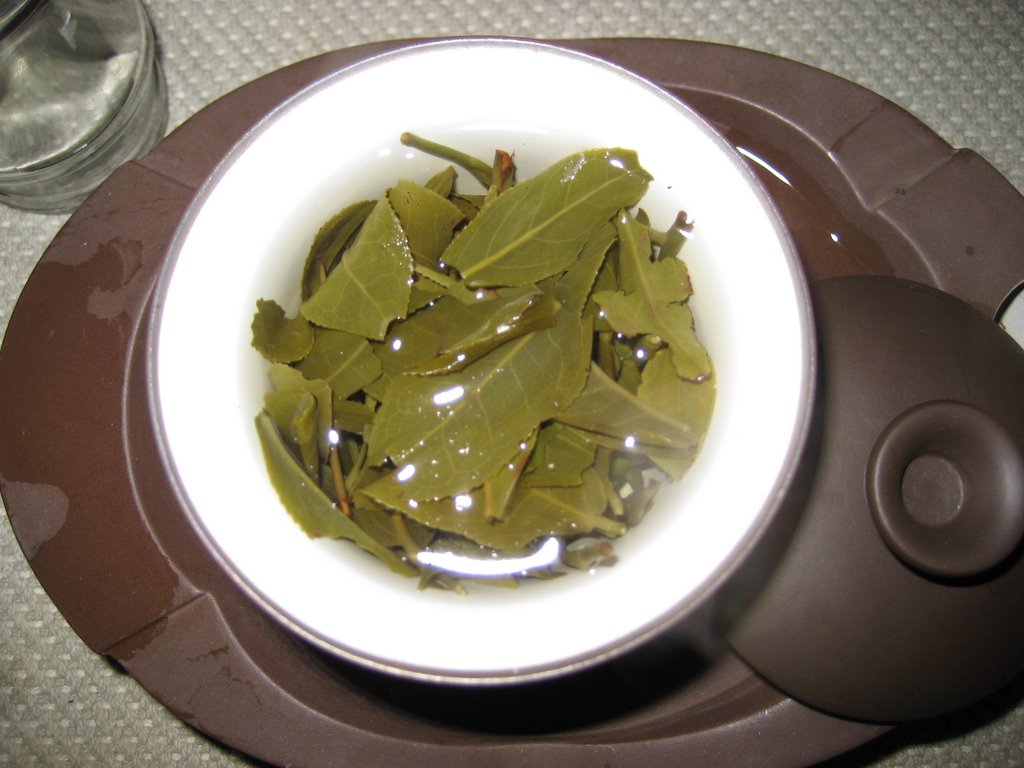
Same amount of water was used and heated with microwave, some reached boiling sooner than others, mineral content plays the key role in this effect. Same amount of tea leaves was added quickly, so they were all infused at the same temperature relatively speaking. Tea leaves used is Jasmine Bi Luo Chun Green Tea .

I did not taste the tea, they were left out in the air over night, I just don't feel like tasting them. This might be the most important step left out of the test. Oh well...

Deposits are visible along the water line as a ring of residues after chemical reactions. Rating: 1 = most deposits, 10 = least deposits

1)
Crystal Geyser - natural alpine spring water
Source: California Sierra Nevada Mountain
Water taste: not sweet, heavy, hint of mineral taste, alkaline
Result: sign of reaction, slight deposit on side of cup
Rating: 5

2)
Aquafina - purified drinking water
Hydro-7 purification, reverse Osmosis
Water taste: crisp texture, lack of flavor
Result: no deposit, as pure as it can get
Rating: 10

3)
Fuji - natural artesian water from islands of Fiji
Silica 85 mg/litter
Calcium 17 mg/litter
Magnesium 13 mg/litter
PH 7.5
Bicarbonates 140 mg/litter
Total Dissolved Solids 210 mg/litter
This claim sounds like a hype to me.
Water taste: too smooth, mineral taste, alkaline
Result: a lot of deposit, reached boiling first among all samples, darker color tea soup
Rating: 3

4)
Refresh - spring water, safeway brand
Source: Baxter natural springs, California
Water taste: smooth, mineral, heavy in iron taste, slightly alkaline, hint of bitterness, slight sourness after taste
Result: medium amount of deposit
Rating: 6

5)
Trader Joe's natural mountain spring water
Source: Olancha, California
Water taste: smooth, no significant taste
Result: very little deposit
Rating: 4

6)
Arrowhead - mountain spring water
Source: natural mountain sources in the US and Canada, unspecified location
Water taste: between smooth and crisp, alkaline, sour tone
Result: a lot of deposits, darker tea soup
Rating: 2

7)
Glaceau smart water - vapor distilled water + electrolytes (calcium chloride, magnesium chloride and potassium bicarbonate)
http://glaceau.com/ Pure as the first drop of rain? Rain = pure???? Boy, marketing = you can say what ever you want???
Water taste: crisp, clean tongue feeling, no significant taste
Result: very little deposit, clean tea soup
Rating: 8

8)
Trader Joe's Pure New Zealand artesian water
Source: an ancient aquifer nearly 300 feet beneath the surface of the earth, rich in minerals, added nothing and taken nothing away.
Water taste: smooth, hint of sweetness, clean taste, sweet after taste as well
Result: very little deposit, clean tea soup
Rating: 9

9)
Glacier vending machine reverse osmosis purified water
http://www.glacierwater.com/quality.htm 6 filtering steps
Water taste: clean refreshing, between smooth and crisp, hint of sweetness
Result: very little deposit
Rating: 7

10)
Lovely Southern California tap water
Water taste: crisp, chlorine, lime, chemical *YUCK*
Result: the most deposits, darkest tea soup, signs of lotsa reaction of chemical in water and tea
Rating: 1

I find the best tasting water are Trader Joe's New Zealand artesian and Glacier vending machine water, also most suitable for tea brewing. New Zealand water is the winner in taste and being all natural, however expensive. Glacier is still my #1 choice for taste, availability and economical reason. Aquafina is the purest out of all, but lack of taste. I'd avoid Fiji, arrowhead and of course tap water for both drinking and making tea. The rest can be ignored.

Water tested are only a few that I can get out of one trip to 2 stores. Anything else that are left out, I'd encourage you to do the same test and share your results.

Saturday, September 23, 2006

Dong Ding oolong spring 2006


Dong Ding ooglong spring 2006

Medium to high fired, $60 per pound, negotiable price, single estate crop from Li Shan, unknown producer. Seller is Lao Zi Hau (Old Brand), small snack shop vendor in every Shun Fat grocery store. This turns out to be a good find at a relatively low price.

3 oz, gaiwan, lobster eye to boiling water

Dry leaves: large pellets, even color and size, long stems are visible, aroma is more like Tie Guan Yin, sweet ripen fruity fragrance

1st brew: 10 sec, I did not wash this tea, turns out it was a wise choice. Very fragrant, lovely floral, liquid is light greenish yellow, no obvious taste, just a lot of aroma

2nd brew: 10 sec, more yellow than previous brew, less fragrant but still a very good smell, sweet and roasty taste, smooth and refreshing, no sign of any astringency or bitterness, nothing unpleasant

3rd brew: 10 sec, similar to 2nd brew, sweeter and roastier

4th brew: 15 sec, still a lot of flavor, less fragrant

5th brew: 30 sec, shrimp eye water, blend, just very blend

6th brew: 30 sec, lobster eye water, sweetness and roasty flavor came out again, fragrance is also detectable

Open leaves: smaller than usual ooglong, might be a small leave varietal, some leaves show red brownish rim, and most of them don't, a sign of uneven fermentation and light fermentation, young and tender leaves, hand picked, stems are too long.

Over all, this is a good tea, especially for the price. It's about the same quality of the $100+ ooglong/tie guan yin from Ten Ren. It can take high boiling temperature, unlike usual ooglong. This kicks it up a notch. My impression is, good tree varietal, if leaves were more carefully picked, evenly fermented, it could have a better result. I made 10 brews out of it.

Thursday, September 21, 2006

Cricket fight container


Cricket fight container - hand painted, 6 little breathing holes, early 1900's. It's perfect for aging small pu-erh.

Ji Xiang Ru Yi zisha hu


A tea enthusiast I met at YHF recommended this vendor to me. It's a Taiwanese snack shop also carry loose tea leaves - Taiwan tea exclusively. I bought a Zisha teapot from him along with a Dong Ding Ooglong. He gave me a free sample of the Taiwan Lung Jing as well. He's a hard selling sales person, over informative as well. I was a little annoyed.

Medium minus quality tea pot. I have seen many teapot made with mixed clay with sparkling particles, usually it's a bad sign. The mineral cause tea to taste alkine resembling soap.

This pot also has the sparkling particles. I am not sure whether I'd use it, maybe I'll try a sample.

Wednesday, September 13, 2006

Mood and tea

I usually pick a tea that is suitable to my mood and the weather to drink. I do believe tea taste differently according to moods, how so scientifically, I don't know. For the last few days, my taste buds are so numb, I can't taste anything right, not even my favorite tea. So I end up just drinking not so favorite tea in various combinations to revive my taste buds. It's not working either. Strong pu-erh turns me off right now, anything heavy and smoky, yuck! Ooglong is too pretentious; wild pu-erh has a nice easy fragrance but soup is uh too alkaline; green tea is too grassy. My taste buds truly reflects my edginess. It must have something to do with my body changes associate with the healing process, also the hormone changes associate with the stress.

Monday, September 11, 2006

Re-roasting old tea leaves

I re-roasted this Unknown age Lung Jing out of curiosity. I had never roasted tea before, but recall a Hong Kong TV fiction series about a village of people made their living in the tea business, one of the episodes was about some rookie messed up a batch of tea, they had to re-roast it with a mixture of other kind of tea to reverse the flavor. I don't think it will do what it claimed to do, but it's an inspiration. I am feeling better today physically - more mobilized than the last couple of days, so I decided to "revive" my Lung Jing by roasting it with low heat for a short time. There is not a touch of "properness" to my method, just playing with my tea otherwise I'd not drink.

I put half of what's left, about 5 grams in a little bowl and set aside. Preheat an enamel glazed cast iron pot at medium on an electric stove for about 2 minutes. I use my bare hand to test the temperature, it's about 140 degrees or lower approximated. I then put in the Lung Jing, swirl the dry leave by holding up the pot, then set it back on the stove for 10 seconds, then swirl again, repeat for about 5 times. By the 3rd time, I can smell the fragrance already, it gets stronger, sweeter and woodier. I then pour the leaves out of the still warm iron pot immediately. The aroma was a bit like cooked pu-erh, still strong while it's warm. The cast iron pot can hold the temperature relatively steady and evenly, the reasons why I chose it.

I made 2 cups of tea using the un-roasted and the re-roasted leaves, side by side, using same cups, same amount of hot boiling water, same amount of leaves in each - about 30 leaves (approximated Phyll). The re-roasted leaves are slightly orange compare to the unroasted, smells woody and a hint of caramel, tea soup is smoother as well, no significant color change in liquid.

It might not be roasted long enough, for the aroma subsided quickly as the leaves cooled down. There is still a small difference in aroma when smelling side by side.

Fun experiment! I will try roasting with other teas that I don't like, perhaps I'll mix and match! Curiosity kills a cat? Oh well, curiosity is in my blood. Sorry, no pictures... It will be at least a week for my credit cards to be mailed here and then more mailing time for the camera.

What camera to buy?

I am thinking of buying the Canon A640 camera. It has features I must have: vari-angle LCD, 10.0 mp and UNDER $400. However it's not compact, but I rather trade it with vari-angle LCD. I travel alone some times and it's handy for taking pictures of myself. This model is too new, there isn't any user rating/reviews online yet. Any suggestions?

http://www.usa.canon.com/consumer/controller?act=ModelDetailAct&fcategoryid=145&modelid=14109


Change of must haves: vari-angle LCD, 5 MP and up, rechargable battery, under $400.
Canon if possible, compact preferred.

Wednesday, 09/13/06
I think I have made my decision, Nikon coolpix S10 as is. Things I like about it:

1. swivel lens, even better than canon swivel because the lens itself can be tilted not only the LCD as in Canon or other brands.

2. Lens, 10x Zoom-Nikkor, impressive for a pocket camera. Not an upgrade from S4 though.

3. Macro shooting enables shooting from as close as 4cm (1.6 in.), great for taking close up pictures of tea and orchids.

4. 5 movie modes with sound plus Time-Lapse movie mode; Electronic VR available Choice of White Balance

5. LCD monitor: 2.5-inch type, 230,000-dot TFT LCD monitor with brightness adjustment, more than doubled the dots of S4.

6. Movie: w/Electronic VR, With sound: TV movie (640) at 30fps, Small size (320) at 30fps, Smaller size (160) at 15fps, Pictmotion (320) at 15fps; Without sound: Time-lapse movie at 15fps. 30fps is much better than my s500.

7. Power requirements: EN-EL5 Lithium-ion rechargeable battery (included), MH-61 battery charger (included). Big step up from S4 which uses 2 AA.

All these things justified the $100 extra dollars. Oh, it's better looking than S4 too. I am settling for this one. Just have to wait for my credit cards to come in. Should have been here already!

S10 at Nikon site

S10 at Photographyblog

S10 at dpreview


Thanks a million Phyll!

Thursday, September 07, 2006

Cheating with coffee


I had an affair today. Yes, I cheated with coffee. A break from tea tasting is needed before I develop a better way to document my tasting notes.

I stop drinking coffee for a few years since I discovered a strange allergic reaction to my health. However I still drink coffee a few times a year. Strange enough I managed to learn to make an exceptional cuppa coffee that's 100 times better than Starbucks or Coffee Beans or Peet's. Peet's would be my choice when I meet with friends.

Ethiopian Harar Horse Lot 30- 03/06
Tom at Sweet Maria puts it this way: Harar is intense. A really good Harar is a coffee that is fruited (blueberry to apricot), has flowery enzymatic aromas, jasmine tea, maple woodiness, exotic hide or fresh leather, mulling spice and chocolate... in other words, good Harar is like the fragrance of an open-air Arabic market! Harars have pungent rustic chocolate roast flavors and a range of winy to fermented fruitiness.

The crop I have is an excellent Harar with blueberry flavor. Dry processed green beans, city roast - about 10 minutes on my i-roast 2 electric roaster for half a cup of beans, 4 minutes air cooling time. Roasted beans are uneven in color, which is the characteristic of dry processed beans. It gives multi-layers of flavor, add a touch of earthy tone to the cup. Using Cuisinart burr grinder, fine espresso grind, Bodum syphon vacuum coffee maker, Glacier filtered water. Whaola, a cup of fresh roasted fine coffee! A table spoon of condense milk made it silky smooth. Since the process is long and involved many steps, I roasted 1/2 cup of green beans which I won't be able to finish within 7 days, I made iced coffee with the rest of the beans. The exact richness I crave once in a long while. Tea is my love but I can use a cup of coffee every now and then.

Wednesday, September 06, 2006

Alcohol burner

Burner - I use an alcohol burner on a daily basis. I don't own an electric water kettle, however I have one of those electric boiler that keeps water at 190 degrees and it's stored away. I personally prefer open flame burner, the warmth and vibrance of the flame add an other layer to the tea experience. It's raw as the ancient days, minimizes modern day tech influence on my tea.

The red clay burner can be found at Wing Hop Fung, comes with a glass bottle and a wick. It's compact, portable and heat efficient, the enclosed small space with a little air hole keeps the heat at bottom of the pot to the maximum. Flame size is adjustable by lifting up the wick or lower it. It can boil 750ml of water in less than 10 minutes with large flame.


The other set up is inspired by Japanese burners. Using a flower pot as the base, a bottle with small neck, a metal pin to stabilize the wick, a metal rack that elevates above the flame for setting the teapot on. I use the big globs of cotton that fill up medicine bottles as wicks, they are lengthy enough to dip into the bottom of the bottle and very absorbent, which means large flame. I use this set up when I use a larger pot for more people. All parts together cost under $10. Not heat efficient due to large open space.


Since I wasn't sure whether I should use the top part of this tetsubin burner previously, I had to improvise by simply placing a rack inside the base to hold a kettle. I am also on the out look for a large enough pot that can sit on top of the rim without the rack, glass preferred. It's $120 plus tax for this tetsubin at Marukai. It does not come with the lamp, I made my own with an apple juice bottle. Not heat efficient either.


Burning fuel I use is Denatured Alcohol, available in hardware stores with a paint section next to the thinner. Home depot has the gallon size for $15. I buy stove fuel from Boater's World here by the marina, $14 per gallon. Soot free and odor free, well, it leaves a brown/black spot where the flame burns, but nothing is flying in the air like rubbing alcohol. Rubbing alcohol will burn with 70% or more alcohol content, but the soot it releases can ruin your carpet and furniture. You can see the black stains on my clay burner, those were from my early days of using rubbing alcohol before I discovered denatured alcohol. 200ml can last for hours to half a day of burning depending on the flame size.

Russian Caravan


Russian Caravan from Coffee beans and tea leaves

After lunch on Monday, I walked across the street to Coffee beans and tea leaves with my friend to check out their loose tea leaves. The thought of buying tea from them have never across my mind. As we sniffed along the little jars, my friend pointed out this Russian Caravan black tea. I was curious enough to ask the server Justin at the counter whether they sell them in small quantity, he gave me a sample about 3 grams. Free tea! Hooray!!!

Russian Caravan has a distinctive smoky aroma, hundreds years ago large caravans carried tea from China traveled a very long way back north, usually upwards of months of traveling on foot. Along the journey, fire smokes from campfires used for cooking and warming left its marks on teas they traveled with. Hence the name and the heavy smoky flavor.

In mid Ching dynasty - 1700's, Russia consumed as much as 40% of its imported goods in tea alone, 80% from China's famous Jun Shang - a group of very successful business men from Shan Xi province - Jun for short. They dominated China's economy and made up most of the military funds by late Ching. But they went bankrupt due to an outdated non collateral banking system invented by themselves, economy slump during war, also exhausted by the never ending drain for military funds. Some of these business men's housing consisted of 1500+ individual units within a compound, resided over 3000 residents, including 800+ family members by the same last name and maids, workers, gardeners, horse keepers etc., there were stores of everything you can imagine within the compound as well, from tea to gold. There are more than 1000 of these large living compounds preserved as museums in the region today. After watching a documentary film on Jun Shang, I had much respect for the integrity of Chinese business men in the old days, unlike the modern days which I find extremely difficult to deal with and in most cases, not trust worthy. Well, this is a whole different topic.

1.5 gram in a gaiwan, boiling water, using Kung Fu Cha method

Dry leaves: dark brown, a few silvery leaves mixed in, sign of machine cut, very strong dry roasted prune aroma, caramelly, smoky

1st brew: pour immediately, red brown color, prune juice without sugar taste, fermented fruity aroma, sour tone, leaves a dry sensation in the back of my throat, unpleasant

2nd brew: 5 sec, deep red brown color, I think this is how dried prune steep in hot water might taste like, fermented fruity aroma, very sour, very dry, using Phyll's words, donut hole feeling in the back of the throat.

3rd and 4th: 5 sec each, similar taste

5th: fermented and smoky aroma and taste is lighter, a hint of sweetness, sour taste is almost gone, still a donut hole sensation

6th and 7th is much better in taste, I am surprised by the long lasting flavor.

After taste: sour, fruity, prunie, dry in the back of mouth and throat

This confirms my tea instinct is correct for not buying tea from such vendors.

Tuesday, September 05, 2006

Unknown high mountain oolong


Unknown ooglong, a friend gave it to me as a present after her trip to Taiwan.

3 grams in zhisa pot, crab to lobster eyes hot water, quick wash

Dry leaves: Dark green/brown, sign of a darker roasting ooglong, heavy bamboo smoky aroma, even size, look and smell are both pleasant

1st brew: leaves are half way open, color is amber as in picture, clear, aroma is sweet smoky English tea like, caramel and a bit milky in taste, texture of soup is somewhat smooth, kinda fresh yet mellow

2nd brew: darker amber, stronger smoky English caramel flavor, the greenness of ooglong is coming out, a slight hint of sourness

3rd brew: still a lot of caramel flavor, texture is more crisp than before

After taste: milky caramel smoky, no sweetness

Open leaves: large leaves with stems, 2 leaves and a stem mostly, no obvious signs of fermentation, hand picked

This looks and tastes like Jin xuan ooglong of Taiwan, it has the same degree of fire roasting, similar characteristic in smell and flavor. It looks better than its taste, it could be the aroma escaped through the box over time. Over all quality is not bad, not on top of my list though. I made 5 brews, it's very weak by then.

Tea at the beach


A tea crazed friend I met at the Vegas tea expo, having tea at the beach last night. We stayed from 6pm till 11:15pm, ordered pizza delivered to the beach. It was nice to watch the 3/4 moon oscillating and its silhouette changed its contour on the water. It went from a line to a spot light to elliptical then disappeared then an endless runway of shimmer to the end of earth.

We had Huang Jin Gui Ooglong at the beginning and Tea tree flowers when it was late.

Saturday, September 02, 2006

Dried cherry stuffed poussin

My girlfriend and I went out for dinner tonight at a local restaurant Lasher. She had dried cherry stuffed poussin last time we were there. She was madly obsessed with it. Day dreams of it for weeks, and when we decided to go, she was in trance for a day. She didn't even have to look at the menu tonight, only to find out the chef left the restaurant a few days ago to pursuit something else other than cooking. She was crushed! We grilled the waitress for more information about the chef, where can we find him etc. I feel quite bad for not going 2 weeks ago. I feel obligated to find another restaurants that serve similar entree. My fellow LA friends, if you know of a place serve dried cherry stuffed poussin anywhere in the area, be it LA, OC, RS, SB, Kern, Ventura, Santa Bernadino county, please please let me know, please help me find her little hen! A million thanks!

Friday, September 01, 2006

Preheating a vessel with water

Preheating a vessel.... A difficult achievement for me for living in Southern California. After a girl friend of mine did an extensive research on water quality on the web, she discovered that the best quality of drinking water are not from a bottle, rather filtered water with complex filtration system - at home or water vending machine. I don't have the luxury of having such a unit in my apartment. So filling up jugs and jugs of water became routine. I tried a few vendors, my favorite is Glacier - vending machine at supermarkets. It includes 6 filtering processes. The water taste sweet by itself. These machines are well maintained with a scheduled filter change and testing.

A vendor at the Vegas Tea Expo was selling these commercial filtration units, they claim the process will first remove all the chemicals of tap water, then remove ALL the minerals, ultra violet light for killing germs and bacterias, then more filtering, then ADD a combination of essential minerals back into the water as a final process. The system cost $2500 each and a maintenance fee of $400 every 3 months for changing filters. Pretty steep eh! Home units start within a couple of hundreds, around $50 for changing filters every 3 months.

Well, my point being carrying large jugs of water is problematic for me. It's how I broke my finger a few weeks ago! A 3 gallon (I dare not to use a 5 gallon jug) jug full of water fell off the back of my hatch back, I was convinced my hand can withhold the weight of 25+ lbs flying off at a speed multiplied by gravity. What a girl would do for a cuppa good tea!

I am a bit of a Jew when it comes to preheating a vessel, the constant reminder of my still painful swollen finger. Filling up a vessel only half way is as generous as I could be, I know it's not sufficient, BUT.... I'll be generous when I install a unit in my future home.

Thursday, August 31, 2006

Celadon bowls


My rewards for the afternoon antique hunting! I loitered around the gay neighborhood near by this afternoon, came across these 2 beautiful porcelain bowls.

The first bowl is particularly my favorite. Very nice details, even depth of carving, it seems molded or stamped though. Very thin and light weight. It makes high pitch crisp sound when I tap on it. It's a very good size bowl, 350ml. Beautiful curve, traditional Chinese style. The glaze is almond with a touch of yellow in color. I have not seen celadon bowls in this color with this design (Wan Shou Wu Jiang) in recent days. Love it!

The second bowl is also very beautiful, carp and lotus carving with green celadon glaze. It seems made from a mold as well. Lotus is my most favorite flower, even more so than orchids. I collect orchids because they are easy to find and "easier" to take care of. Orchids are not easy plants by all means. But once you learn a few tricks and live here in Southern California by the coast, the chance of survival is better than say Michigan. The shape of this bowl is more straight or stiff? It's also heavier and thicker, same size as the first one. Simple with fine details, very attractive!
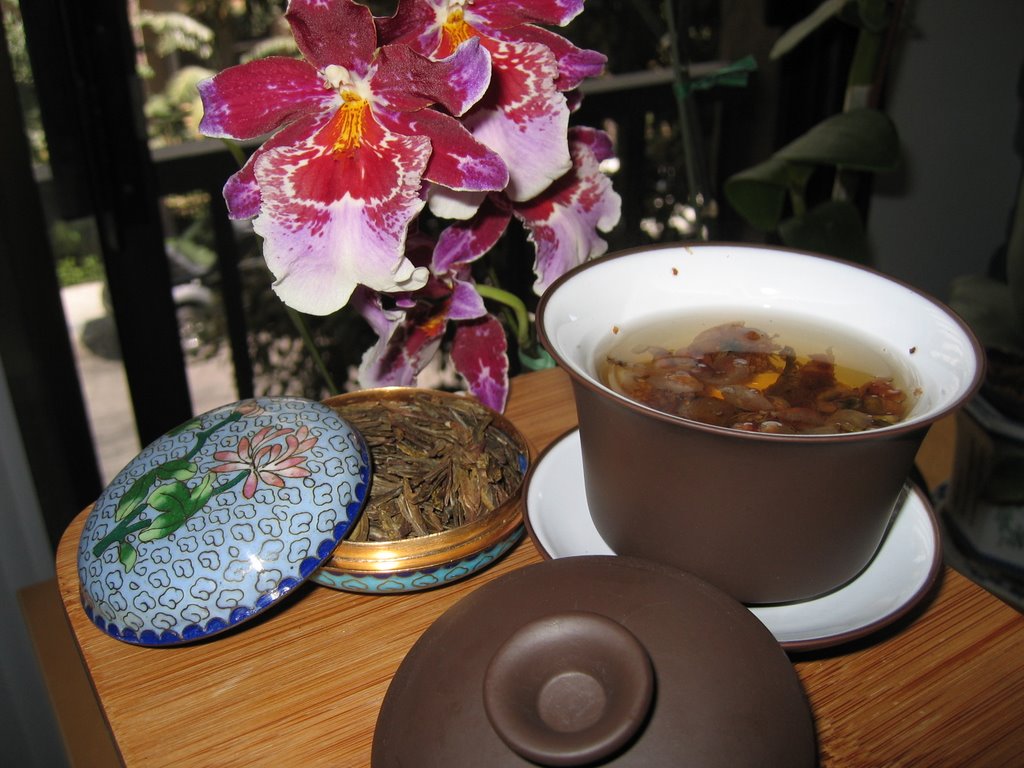
My perception of water

My perception of water:

Shrimp eyes: starting to bubble, small, mostly attach to the bottom, a few floating to top slowly

Crab eyes: medium bubbles, float to top in 1 to 2 seconds

Lobster eyes: large bubbles, float to top quickly, creates a hotspring effect on water surface

Boiling: well, boiling

Wednesday, August 30, 2006

Unknown age Lung Jing from HangZhou, China


Unknown age Lung Jing from HangZhou, China. I was at my parent's house last weekend, as usual, I look through the cabinets and pantry to find more tea. My father is a tea drinker although not as crazy as I am. There are at least 15 kinds of tea remain unopened at my own home, and I am looking for more at tea shops and my father's reserves.

Quantity: 20 leaves, hot water (shrimp eyes) in gaiwan (100ml)

Dry leaves: earthy greenish brown, uniformed, aged aroma unlike fresh green smelling Lung Jing

1st brew: light yellowish color, slight smoky aroma, a bit green grassy taste, smooth, sign of aging in taste and color

2nd brew with boiling water: more yellow than the first brew, clean smooth texture, indescribable light aroma, it can take the boiling temperature quite well, no bitterness or astringency

3rd brew: I added a few blooms of the tea tree flowers, the aged LJ came back to live with honey roasted aroma. I am really digging these flowers!

Opened leaves: it's actually greener! mixture of leave types, one tip, or 1-2 leaves and a tip, good but not the best grade

This should be one of those tea for drinking in the office, make a quick cup, it's not bad but doesn't require "high maintenance" type. Lung Jing is not my favorite choice, I guess it's not one of my father's either. It seems to be aged for at least a year to two.

Tuesday, August 29, 2006

$12,000 tea set


1st prize winner of Taiwan national pottery competition. It comes with a certificate with year, artist information. However I did not have the pleasure of finding out. One and only set in the world, currently resides in Ten Ren located in San Gabriel, Ca. Price tag a whopping $12,000 USD that is. I suppose it takes much more knowledge than what I have to appreciate this set of Yixing tea set.

Friday, August 25, 2006

Tea at the beach with a neighbor


I had tea at the beach this evening. I took my blanket, pillow, kungfu tea set, burner, a pot of hot water, a book to the sand, arrived little before sunset and stayed till stars filled the sky, lights were shimmering on the water waves. Orange sky turned into mysterious darkness layered with haze over sparkling stars hanging above. It's breezy but not cold, very humid. Breeze came from every direction.

I take my tea every where I go for leisure, especially to the beach. Tonight is the first time I stayed well into the night on the sand. One can experience tranquility at another level.

It's difficult to keep water boiling at the beach, finally I had to put the burner inside the basket to shelter from the wind. I chose Huang Jin Gui Ooglong for the night, its light and fragrant character went well with a warm humid summer night. Sorta like floating on a bed of lotus leave, until some one popped my bubble.

Tuesday, August 22, 2006

Hang Zhou tea house

    Check this out:


Monday, August 21, 2006

Flower tea


While we are on the subject of tisane, here are a few I have. Lavender in purple, jasmine in white, rose bud in red, osmanthus in yellow.

I always like mild light tea, no mater it's tisane or actual camellia sinensis. Half a tea spoon of the small flowers such as lavender, osmanthus is sufficient enough without overpowering your smelling sense and taste buds.

5 rose buds in a cup of boiling water steep for 1 minute is all it takes to bring out the fragrance and sweetness. It can last 3 brews.

Jasmine, this particular batch is not good in quality. I am not sure if it'd taste any different for others. My mother just bought a jasmine plant, I'll collect the buds once the plant matures, see if it makes any difference.

I remember when I was little, the local Southern Chinese collect flowers from various subtropical plants for tisane, such as fresh honey suckle, Mi Lan (not sure what that is in English), fresh rose, jasmine, etc... Each has it's own health benefit, cooling or detox/cleansing property usually.

Wednesday, August 16, 2006

Tea flower bing


Tea flower tea? This sounds odd. Anyhow this is a bing of flowers from tea trees. It taste great with only a few blooms at a time. Honey roasted sweet aroma, actual tea flavor in taste. I might try it with some "less great" tea to see if I can create a new concoction.

Purchased from an Ebay seller for $12.50 plus shipping. At 5 blooms per cup without resteeping, this bing will last for an eternity. The calligraphy is a nice little souvenir too, I am keeping it on a scrap book. It's actually handwritten.The scent of seed oil functions like a perfume ad in a magazine except better and possibly keeps bugs away too.

Tuesday, August 15, 2006

Broken finger

I broke my little finger a few hours ago..... I won't be able to type much for a while. However I'll attempt to put up some pictures.

Fish cups


A pair of porcelain hand painted fish cups. Love the classic blue and white, less is more.

Saturday, August 12, 2006

Wild Pu-erh Qizi Bing 2003, Yiwu, Yunnan


Wild Pu-erh Qizi Bing 2003, Yiwu, Yunnan. Courtesy of Stephane Erler - Teamasters@blogspot.com.

Special thanks to Stephane. Here is my tasting note of this Pu-erh tea.

Tools used as in picture.
Water: boiling
Tea quantity: 1 gram
Dried Leaves: Greenish brown, sign of aging green pu-erh; young white haired mixed with mostly matured large leaves; smells like well aged smooth tobacco with light fragrance.

1st brew: medium amber color, a lot of wild pu-erh taste, fragrant with some fermentation taste, no astringency, no sour or bitter taste, good sign of good tea, looking forward to 2nd brew.

2nd brew: medium amber color again, still a bit of the aging pu-erh taste, fragrance is getting more intense, 10 minutes after drinking, a lingering sweet wild floral taste roaming inside of the mouth, very enjoyable, crisp clean texture while and after drinking tea soup.

3rd brew: light amber color, very clean texture in mouth, no aged tea taste, fragrance is still intense, lingering sweet taste with fragrant aroma can be detected with every breath.

4th brew is similar to 3rd, I got 7 good brews out of it. The clean crisp texture made me feel like the next day after a dental cleaning. Very lovely tea, the wild pu-erh fragrance is very floral like the scent after a summer afternoon shower.

Tuesday, August 08, 2006


A few from my collections.

Saturday, August 05, 2006

Tetsubin water burner


My Tetsubin water burner. I bought this a few months ago at a Japanese store. After the first use, the top part - water container started to rust. I was quite disappointed. At this time, I can only use it to warm Sake. Perhaps there is a way to re-glaze the interior to prevent rusting, which must also be non-toxic as well. Any suggestion is welcome.

Thursday, August 03, 2006

Jasmine tea


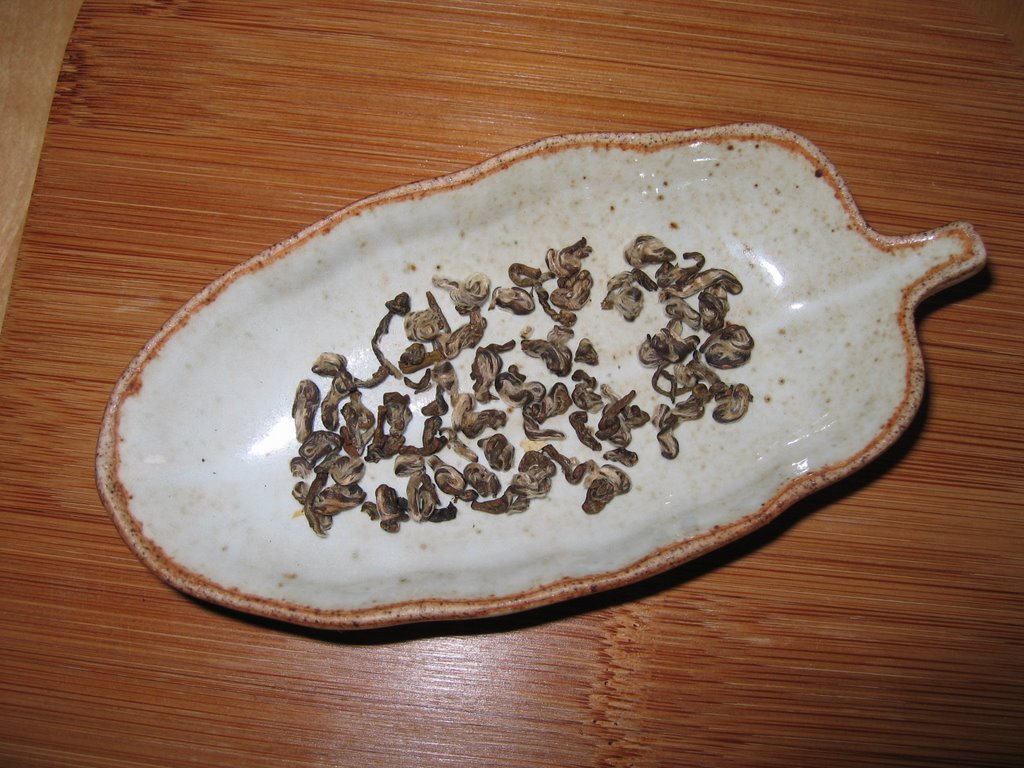
Jasmine tea - there are many varieties of jasmine tea, from china and Taiwan. Common ones from China are in dragon pearl (3 or 4 leave tips rolled into a ball), twisted knots or dragon fly (single leave tip in knotted or dragon fly shape), and small pearl forms (single leave tip rolled into small pellet). Taiwan on the other hand is loose leaves of green tea mixed with jasmine buds. The lowest grade (dim sum) of jasmine from China is also processed the same way as Taiwan. There is an overwhelming demand for jasmine tea in the west. Methods of processing of jasmine tea have also been altered to meet the demand with competitive price. Dragon pearl jasmine tea are commonly scented with artificial flavor. Tea leaves has an amazing absorbing property which made it possible to add floral fragrance for flavoring enhancement. Traditional process of jasmine tea is long and tedious. When green tip tea is picked and processed into dry readily drinkable tea, fresh jasmine flower buds are wrapped in cloth bags, placed in container containing dried tea leaves, sealed for over night, allowing the leaves to absorb the moisture full of jasmine fragrance. The flowers are then taken out next day, tea leaves are baked lightly to allow moistures to evaporate. New batch of fresh jasmine flowers are placed in sealed container along with tea leaves again for another night of absorption. This process repeats 7 to 10 days for maximum flavoring.

The difference in taste is rather noticeable. In dry form, artificial flavored jasmine tea associates with a sharp perfume like smell, rather intense and pungent. The naturally infused jasmine tea, on contrary, has a mellow, mild lingering aroma which is very refreshing with a hint of sweetness in the air. The former tea taste also has a sharp chemical flavor, while the later is smooth and sweet, subtle fragrance of jasmine flows above puff by puff. The former will lose the aroma quick after the first brew, while the later can last 3 or more brews. I saved a small amount of a small pearl jasmine tea I came across in Harbin, China 8 years ago. The fragrance still lingers today without a staled smell. Wonderful tea! See picture.

Wednesday, August 02, 2006

Tea and Cultural back ground

Cultural back ground plays a dominating role in tea drinking habit and tea buying preference. Amount my friends, both Asians and non Asians, Asians are accustomed to drinking tea, and prefer loose tea leaves regardless of the intensity of their knowledge of tea. And because of that reason, in areas where most Asians resides, there are individual tea shops specializing Chinese loose leave tea. Lower grade loose leave tea is also widely available in Asian grocery stores. Unlike American grocery stores, even specialty food stores like Trader Joe's and Wild oats, you can only find tea bags. Any how, from my experience of trying to introduce Caucasian friends to tea drinking, they are in awe when I made Kung Fu tea for them, however it's not enough to inspire them to start buying loose leave tea. Convenience is the main factor in choosing tea bags over loose tea leaves. They love it when I buy for them. Go figure... I love sharing good things in life.

There was one embarrassing incident years ago. I took a date to Ten Ren Tea, he asked me which tea has the most anti-oxidant effect. While I tried explaining to him that drinking tea is an appreciation of the tea, flavor, aroma, vessels and artisan presentation combined as a whole, he looked at the prices, it was in the $50 range, his enthusiasm was immediately diminished. I was embarrassed. Well, you can guess what happened to my date after that. HA

It is my firm believe that in making choice of anything in life, knowledge will ultimately drive us to make better decisions. It's the fact that education helps us advance in career, so it should hold true if we have the inquisitive mind to learn about tea and in turn it will steer us to choose the tea that's suitable for us instead of base on convenience.

Tea being such a delicate yet complicate drink, that requires a sufficient amount of time and knowledge to identify good tea, and particularly bring out the best of a tea leaf in an infusion. Majority of American, Asian or non Asian do not have the motivation, inquisitive mind nor the time to cultivate the pleasure of tea drinking. With all the hypes of health benefits associated with tea drinking, mass available supermarket tea bags are what's only known by consumers. Something that took thousands years to perfected will not be immediately adopted by a young country like US. Even the Europeans have been drinking tea since the 17th century, have yet to grasp the spirit of tea drinking like Chinese do today. The way Americans consume tea will remain focused on tea bags of lower grade leaves for many years to come. Surveys show only 5% of tea sales compare to 95% coffee at any coffee houses in America. I was also amazed of the number of attendees at the Tea-expo at Las Vegas in March of 06, 3500+ was considered a great turn out compare to last years attendee.