It's not good news for any of us, tea drinkers, tea merchants, and tea farmers. Snow storm wiped out 30% of the tea farms in China. 10% tea trees are frozen to death. Green tea productions will be delayed by almost a month. First crop will be on market by mid March, where previous years first crop were available shortly after Chinese New Year, right about now. Prices are expected to go up 30% for Spring 2008. Current market is made up by last year stock, price has already gone up 30% as well for last years crop. However, quality of 2008 Spring teas are expected to be higher. There's at least one thing to look forward to.
Consumers have many choices: pay more for quality teas, pay the same and drink less quality teas, switch to Indian, Ceylon, African or herbal teas, drink less tea or stop drinking tea.
Tea farmers will raise price to make up for lost productions.
Tea merchants can raise prices, the consequence is fewer buyers. Keep prices low, the consequence is can we pay rent and expenses?
US tea merchants: USD to RMB is down 40 cents in just 4 months, shipping is expensive, government departments are thieves, minimum wage went up in January, even supermarket prices have gone up 30% to 50%.
China inflation rate is 7% for 2007, 2008 will get worse, USD at more than 1% depreciation rate per month, plus 30% higher price, I will have to stop drinking tea myself.
Want to cry!
Friday, February 22, 2008


Monday, February 18, 2008
Roast tea over fire
Briefly roasting tea before brewing has been a practice since the Tang dynasty. However this form of art is lost in the main stream tea culture, but still practiced by minority groups in rual parts of China. There's a little bit of revival here and there today.
This is a Chao Zhou method of pre-roasting utilizing what's on hand. Paper made roasting platform/Cha He.
Use a 11"x8" clean white paper, fold as in picture blow.
 Cut off the excess trim, leaving a square piece of paper.
 Fold one corner of the square with seam line up with seam, then fold part of the folded corner backwards, see picture below.

Fold paper in half again along seam, hold the "tail" with thumb and index finger as in picture below.
 You can now place tea on paper made Cha He, place over fire to preheat/pre-roast. Fire source can be gas stove (low fire), electric stove (medium to low), or charcoal (low flame). It only take a few minutes, when the aroma starts to show, keep roasting for another 2 minutes. Cha He should be placed 3 to 4 inches above fire. MAKE SURE THE FLAME IS NOT HIGH!!! DON'T CATCH A FIRE!!! And don't suit me if you did catch a fire! :P
 Closing the top can keep the heat even and consistant within the Cha He.
 Finally, when the tea is ready, you can pour tea directly into teapot as a real Cha He. Whoa La!

Have an aromatic and flavorful cup of tea!
This is a Chao Zhou method of pre-roasting utilizing what's on hand. Paper made roasting platform/Cha He.
Use a 11"x8" clean white paper, fold as in picture blow.
 Cut off the excess trim, leaving a square piece of paper.
 Fold one corner of the square with seam line up with seam, then fold part of the folded corner backwards, see picture below.
Fold paper in half again along seam, hold the "tail" with thumb and index finger as in picture below.
 You can now place tea on paper made Cha He, place over fire to preheat/pre-roast. Fire source can be gas stove (low fire), electric stove (medium to low), or charcoal (low flame). It only take a few minutes, when the aroma starts to show, keep roasting for another 2 minutes. Cha He should be placed 3 to 4 inches above fire. MAKE SURE THE FLAME IS NOT HIGH!!! DON'T CATCH A FIRE!!! And don't suit me if you did catch a fire! :P
 Closing the top can keep the heat even and consistant within the Cha He.
 Finally, when the tea is ready, you can pour tea directly into teapot as a real Cha He. Whoa La!
Have an aromatic and flavorful cup of tea!
Wild Child!
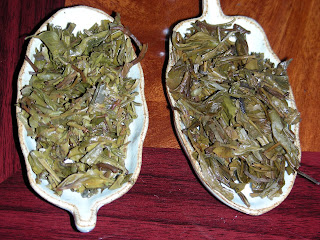
Dan Cong is such a wild child! A few reviews I have observed online mentioned the short lived aroma after 5 infusions. My first instinct was hmm, it can't be. I tried blaming it on water or what not. I then discovered a few Dan Cong behaved the same way when I made them myself which was long lasting a few months ago, it's now loosing it's strength. It's baffling to my curious mind. After hours of digging for information and phone calls to China, I found out this phenomenon is called Fan Chun (Returned Spring). It's actually quite common with oolong teas, wuyi, anxi, taiwan or Phoenix oolong. Weather play a major role in Fan3 Chun1, moisture in the air and low temperature are the keys to fluctuations in taste, for most agricultural products as mater of fact. This is rainy season in southern California, temperature is in low 60s F at high, low at low 50's even 40's for some area. Palos Verdes is humid year round with morning marine layers, this time of year is even more rainier. Fragrance of tea is "trapped", there isn't much you can do with normal brewing method. Well, the question is if this is permanent? No, it's easy to fix with a little roasting. Yes, it's an extra step, but if you are obsessed as I am, it's actually fun. I also have various types of tools to manifest the transformation, it does make it seem easy. However, I am going to show you the easiest way to roast without having to buy any additional tools.
Saturday, February 16, 2008
Who owns most of the aged tea?
Pu-erh tea had many tea drinkers addicted to its aged, decomposed flavor. Other aged teas also got more notice, oolong has its share of followers, aged green teas surface here and there too.
Who has the most stock of aged teas? Who has the financing and storage to hold and house teas for a long period of time? None other than China natural products import and export company, tea subsidiary, even today. Before privatization of tea manufacturers, communist party owned tea company house and control all tea productions via purchasing teas from local farmers. Farmers "sold" their productions to the government, some might leave a small quantity for their own collection. Majority of aged teas are still within control of the Tea subsidiary of local provinces. Only small quantity is available on the market.
Aged teas by farmers can be either intentional or circumstantial, however majority of the teas own by the government are most likely aged circumstantially.
Who has the most stock of aged teas? Who has the financing and storage to hold and house teas for a long period of time? None other than China natural products import and export company, tea subsidiary, even today. Before privatization of tea manufacturers, communist party owned tea company house and control all tea productions via purchasing teas from local farmers. Farmers "sold" their productions to the government, some might leave a small quantity for their own collection. Majority of aged teas are still within control of the Tea subsidiary of local provinces. Only small quantity is available on the market.
Aged teas by farmers can be either intentional or circumstantial, however majority of the teas own by the government are most likely aged circumstantially.
Destiny of a tea leaf
In an hour of commute on a Saturday morning, thoughts came across my mind is nothing far from tea. Now that my tea shop's into its 9th month of operation, much of the tea related daily thoughts are inventory, tasting, who likes what tea, things I know and things I don't know about teas.
This morning, my thoughts went a step further, if I were a tea leaf full of flavor and substance, what's my destination? The optimal result would be end up in a cup of hot water releasing all the flavor?! Meet the right water, wait for the right temperature and use the right utensils. Making a good cup of tea is some what like meeting the right person as a mate. If the water was good, tea flavor can be enhanced, on the other hand, a fare mannered girl can become bitchy. If the temperature was hot enough, the substance can be released, if too hot, the bitterness will also come out. On the other hand, flavor of tea will not be revealed, a fun persona could become boring. If the utensils were wrong, tea would be bland. On the other hand, the right utensils can magnify the good and round off the bad. The right persons can inspire one and other to learn, improve, progress, and excel.
If I were a tea leaf, where is my water?!
Collection of scattered thoughts.
I got up on a Sunday morning thinking, this post sounds too much like an online dating profile. HAHA
This morning, my thoughts went a step further, if I were a tea leaf full of flavor and substance, what's my destination? The optimal result would be end up in a cup of hot water releasing all the flavor?! Meet the right water, wait for the right temperature and use the right utensils. Making a good cup of tea is some what like meeting the right person as a mate. If the water was good, tea flavor can be enhanced, on the other hand, a fare mannered girl can become bitchy. If the temperature was hot enough, the substance can be released, if too hot, the bitterness will also come out. On the other hand, flavor of tea will not be revealed, a fun persona could become boring. If the utensils were wrong, tea would be bland. On the other hand, the right utensils can magnify the good and round off the bad. The right persons can inspire one and other to learn, improve, progress, and excel.
If I were a tea leaf, where is my water?!
Collection of scattered thoughts.
I got up on a Sunday morning thinking, this post sounds too much like an online dating profile. HAHA
Thursday, February 14, 2008
New Year tea party

Chinese New Year was last week. We celebrated this holiday tradition with a tea party. Many guests arrived with festive spirit, some were dressed up in Chinese traditional clothes. It was a fabulous event. However I was too busy to take any pictures. Above picture was taken today before all holiday decorations were taken off. I did not get a chance to drink tea with the LATA gang, aged pu samples sent by Paul of Sacred Tea were supposed to be tasted with members, but we did not get to drink any. We will try to schedule the next meeting soon.
Thank you for your generosity Paul! :)
Wish everyone a happy new year, may good tea fill every cup of yours in this new year! Cheers!
Tuesday, February 12, 2008
Traditional roast vs "new" light roast
Consumers are leaders of trend in tea, as in everything else in this world, be it fashion or life style. In recent days - less than 20 years, Qing Xiang (light fragrance) oolong has crept up market share to dominate in current market. Many old timer tea drinkers are complaining the new trend is digressing from the traditional. From an industrial point of view, producers will always make anything to meet market needs. You can roast all the tea you want in traditional roasting, and try as hard as you can to push for a sale, but if consumers do not buy, there is nothing you can do but to bend your wills. Tea producers and merchants have to make sales to make profits to put a roof over their head and take some bacon home to feed their wives and children.
So why do most consumers prefer Qing Xiang teas? It has to do with drinking habits of the majority population. Oolong tea did not travel far into inland of China before modern transportation. Out of all the tea producing regions, Fujian and Guang Dong are small and limited with production. Most teas from the 2 regions were sold to foreign countries with seaports right at home. What do the rest of the country drink, even today? Green tea and flower scented teas! Habit is something you grow up accustom to, with little incentive or need to change. When oolong is not known or available, green tea drinking habit is unshakable. However, modern day trading is effective and fast, mobility of tea allows green tea drinkers to have a taste of oolong, pu-erh, liu an and even dajeeling in China. Habit is hard to change for many, green tea drinker will have a hard time adopting the taste of heavy roasted flavors. Facing a large market aim at green tea drinkers, either produce something lighter in flavor resembling green tea or leave that segment of market. As good business men that Chinese are, new products are created to meet the demand. There is nothing wrong with that. There are demands all across the spectrum of the roasting degree during any time space, now, then and later, just the mater of more or less. Even the concept of "new" for qing xiang is not new.
Combing through dozens Qing Xiang oolong to find one traditional roast is a chore I admit. But it's not extincted. Like searching for any good tea, it takes effort. There is always an other way to accomplish your goal, roast your own tea! This is actually much easier to achieve than finding fundamentally good quality tea - good raw materials to process into superior flavorful tea.
Advantage of traditional roast: longer shelf life, more complex flavor and texture, suitable for aging, easy on stomach.
Advantage of light roast: floral fragrance, easy to drink for green tea drinkers, shelf life is shorter but no longer an issue due to new economic power with more disposable income.
So why do most consumers prefer Qing Xiang teas? It has to do with drinking habits of the majority population. Oolong tea did not travel far into inland of China before modern transportation. Out of all the tea producing regions, Fujian and Guang Dong are small and limited with production. Most teas from the 2 regions were sold to foreign countries with seaports right at home. What do the rest of the country drink, even today? Green tea and flower scented teas! Habit is something you grow up accustom to, with little incentive or need to change. When oolong is not known or available, green tea drinking habit is unshakable. However, modern day trading is effective and fast, mobility of tea allows green tea drinkers to have a taste of oolong, pu-erh, liu an and even dajeeling in China. Habit is hard to change for many, green tea drinker will have a hard time adopting the taste of heavy roasted flavors. Facing a large market aim at green tea drinkers, either produce something lighter in flavor resembling green tea or leave that segment of market. As good business men that Chinese are, new products are created to meet the demand. There is nothing wrong with that. There are demands all across the spectrum of the roasting degree during any time space, now, then and later, just the mater of more or less. Even the concept of "new" for qing xiang is not new.
Combing through dozens Qing Xiang oolong to find one traditional roast is a chore I admit. But it's not extincted. Like searching for any good tea, it takes effort. There is always an other way to accomplish your goal, roast your own tea! This is actually much easier to achieve than finding fundamentally good quality tea - good raw materials to process into superior flavorful tea.
Advantage of traditional roast: longer shelf life, more complex flavor and texture, suitable for aging, easy on stomach.
Advantage of light roast: floral fragrance, easy to drink for green tea drinkers, shelf life is shorter but no longer an issue due to new economic power with more disposable income.
Get to know Phoenix Dan Cong (5) - Old or young
Dan Cong can be rare due to its old age and limited production, but is it necessary better? Here are some of the distinctions between the old and the young.
Under normal growing condition - low altitude with dramatic seasonal temperature changes, tea tree's live cycle peeks around 60 to 75 years old, then it starts to decline and die soon after. During this live cycle, early years is growing cycle, like a baby grows to expand limps, in the case of tea tree branches and root system. However young trees are fragile and weak, hence teas produced from young trees are thin and flat in taste and texture.
As a tree grows into 20's and 30's, the tree is strong and vibrant, with sufficient fertilization, leaves are strong and meaty, production is high. At this stage, flavor starts to develop, but not complex.
At age of 40 to 50's, tree is at its prime, production is high with complex flavor.
At 60's and 70's, the flavor is most complex, however production declines.
Flavor: Tannin is significantly more than older bushes, hence it can be bitter and astringent if brewed too long. Aroma is very up front, sure to give an impression. Texture is thin with sweet honey taste. Young and wild, beautiful and temperamental. Well made teas can last 7 to 10+ brews. Well made commercial teas have an even uniformed look due to production availability. Commercial teas are further separated by size according to grades.
What preserves the longevity of a tea tree one may ask?! Slow growth in cool (not cold) climate with little direct sun ray. High altitude mountain sides facing south-east produce the best teas in the world.
Tea trees are adaptable to shaded environment. High altitude mountains are covered with dense fog for many hours each day, providing moisture and nutrients to the leaves. Dense fog also block off direct sunlight yet allow ultra violet ray to penetrate the cloud layer that photo cells need to transform nutrients into energy. Without direct sunlight, temperature remains low until later in the day when fog layers are cleared. Trees on the south east side of the hill side does not get much direct sunlight even the fog layers are cleared. The hottest sunlight is in early afternoon, which is all over the other side of the hill. Leaves and branches grow slowly in this climate, at the same time root system develops fast with all the nutrients absorbed from the leaves. Big root system and slow growth mean lots nutrients are being stored in each leaf. Older the tree slower the growth.
Flavor wise, aroma is less pronounced as younger trees, taste is complex with multiple layers. Each leaf contains 37% dissolvable substance, ranging 40 to 60+ chemicals by varietal, there is much to discover in your cup of phoenix tea! 20+ up to 35 brews is not uncommon. Its smooth, round texture and lingering after taste are signifier of old bush. Rich but introverted. Old bush teas are some what uneven in look, there are young leaves, matured (not old) leaves, rolled up or open, long whole leaves mixed with a few cut up ones. It contains everything harvested from the same tree without separation by grade. Because of this very practice, it further adds layers of complexity to the flavor of these old bush teas.
Although some may prefer the aroma over taste, old bush taste is not for everyone, definitely takes time and much drinking to learn its beauty. Comparison will reveal quality fairly. I usually advice my customers drink the young before the old, knowing the old will over power the young. However many are caught in the aroma. If you had more than enough for one session, try tasting the young right after the old. Oh well, I'll probably be stuck with all the young crops once everyone discovered the secret. :P
Under normal growing condition - low altitude with dramatic seasonal temperature changes, tea tree's live cycle peeks around 60 to 75 years old, then it starts to decline and die soon after. During this live cycle, early years is growing cycle, like a baby grows to expand limps, in the case of tea tree branches and root system. However young trees are fragile and weak, hence teas produced from young trees are thin and flat in taste and texture.
As a tree grows into 20's and 30's, the tree is strong and vibrant, with sufficient fertilization, leaves are strong and meaty, production is high. At this stage, flavor starts to develop, but not complex.
At age of 40 to 50's, tree is at its prime, production is high with complex flavor.
At 60's and 70's, the flavor is most complex, however production declines.
Flavor: Tannin is significantly more than older bushes, hence it can be bitter and astringent if brewed too long. Aroma is very up front, sure to give an impression. Texture is thin with sweet honey taste. Young and wild, beautiful and temperamental. Well made teas can last 7 to 10+ brews. Well made commercial teas have an even uniformed look due to production availability. Commercial teas are further separated by size according to grades.
What preserves the longevity of a tea tree one may ask?! Slow growth in cool (not cold) climate with little direct sun ray. High altitude mountain sides facing south-east produce the best teas in the world.
Tea trees are adaptable to shaded environment. High altitude mountains are covered with dense fog for many hours each day, providing moisture and nutrients to the leaves. Dense fog also block off direct sunlight yet allow ultra violet ray to penetrate the cloud layer that photo cells need to transform nutrients into energy. Without direct sunlight, temperature remains low until later in the day when fog layers are cleared. Trees on the south east side of the hill side does not get much direct sunlight even the fog layers are cleared. The hottest sunlight is in early afternoon, which is all over the other side of the hill. Leaves and branches grow slowly in this climate, at the same time root system develops fast with all the nutrients absorbed from the leaves. Big root system and slow growth mean lots nutrients are being stored in each leaf. Older the tree slower the growth.
Flavor wise, aroma is less pronounced as younger trees, taste is complex with multiple layers. Each leaf contains 37% dissolvable substance, ranging 40 to 60+ chemicals by varietal, there is much to discover in your cup of phoenix tea! 20+ up to 35 brews is not uncommon. Its smooth, round texture and lingering after taste are signifier of old bush. Rich but introverted. Old bush teas are some what uneven in look, there are young leaves, matured (not old) leaves, rolled up or open, long whole leaves mixed with a few cut up ones. It contains everything harvested from the same tree without separation by grade. Because of this very practice, it further adds layers of complexity to the flavor of these old bush teas.
Although some may prefer the aroma over taste, old bush taste is not for everyone, definitely takes time and much drinking to learn its beauty. Comparison will reveal quality fairly. I usually advice my customers drink the young before the old, knowing the old will over power the young. However many are caught in the aroma. If you had more than enough for one session, try tasting the young right after the old. Oh well, I'll probably be stuck with all the young crops once everyone discovered the secret. :P
Get to know Phoenix Dan Cong (4) - Seasons
Phoenix mountain is located in subtropical climate in southern China, lowest temperature does not exceed 5 degrees C. Most plants in the region are not dormant during winter. Phoenix tea trees produce tea all year round. Production begins around late march as official spring crop, April production is also spring production. May production can be either early summer production for low altitude farms, and still spring production for high altitude farms. June and July are summer productions. August can be either late summer for high altitude or early fall for low altitude. October is winter production. November to February productions is a blur, some times it's call winter-spring crop. Due to low production in fall, winter and early spring, farmers either mix everything together or skip production all together depending on the altitude and age of trees.
Commercial products (young trees averaging less than 20 yrs old) below 800 meters above sea level:
Spring (Mid to late march through early April) - aromatic, sweet and astringent
Early summer (late April to May) - Summer tea - bitter and astringent
Late summer (June through July) - Summer tea - more bitter
Early Fall (August through early September) - Fall tea, aromatic, more than spring production
Late Fall (Mid September through beginning of October) - Fall tea
Early Winter (October) - Fall snow tea, most aromatic out of all season, but lack of flavor
Later Winter (November) - Snow flake tea, mild flavor and aroma
Pre-spring (January through February) - very little production, mild flavor and aroma
Old Dan Cong bushes (50+ yrs old) above 800 meters above sea level:
Spring (April through Mid June). This is the only production of the year. Even though trees will still grow through out the year, growing rate is too slow to produce anything significant, flavor is also not good enough to command high price. Most farmers leave the trees alone to preserve nutrient. It's especially important for trees that are 200+ years old.
Commercial products (young trees averaging less than 20 yrs old) below 800 meters above sea level:
Spring (Mid to late march through early April) - aromatic, sweet and astringent
Early summer (late April to May) - Summer tea - bitter and astringent
Late summer (June through July) - Summer tea - more bitter
Early Fall (August through early September) - Fall tea, aromatic, more than spring production
Late Fall (Mid September through beginning of October) - Fall tea
Early Winter (October) - Fall snow tea, most aromatic out of all season, but lack of flavor
Later Winter (November) - Snow flake tea, mild flavor and aroma
Pre-spring (January through February) - very little production, mild flavor and aroma
Old Dan Cong bushes (50+ yrs old) above 800 meters above sea level:
Spring (April through Mid June). This is the only production of the year. Even though trees will still grow through out the year, growing rate is too slow to produce anything significant, flavor is also not good enough to command high price. Most farmers leave the trees alone to preserve nutrient. It's especially important for trees that are 200+ years old.
I'm back
Sorry for the lack of posting in the last couple weeks. Between Chinese New Year and getting ready for Valentine's Day inventory, training, tasting, paying tax, I got my hands full. It's been a while since the last Dan Cong topic. I'll work on the series later today.
Saturday, February 02, 2008
Commercial grade Dan Cong samples - Feb only
Tea for all in the new Lunar year!
Sample pack of commercial DC for $8 including shipping in US, $12 to Europe. For those who place orders during Feb will receive this sample pack for free. Limit of 30 sets --- Sold Out.
Each sample is 5 g
97 Honey Orchid $6/oz (New)---Heavy roast taste, robust and strong flavor
07 Honey Orchid special grade $9/oz (New)---Medium to heavy roast, strong honey orchid taste
07 Fall Orchid first grade $6/oz (New)---Sweet honey, floral aroma
07 Huang Zhi Xiang first grade $6/oz (New)---Citrusy, strong qi, mellow honey taste
07 Yu Lan Xiang first grade $6/oz (New)---Magnolia fragrance, sweet, a bit astringent
07 Da Wu Ye special grade - Big Dark Leaf $9/oz (New)---Light roast, floral nectar
email: tea at teahabitat dot com to reserve your sample pack :)
Accept paypal and checks
Sample pack of commercial DC for $8 including shipping in US, $12 to Europe. For those who place orders during Feb will receive this sample pack for free. Limit of 30 sets --- Sold Out.
Each sample is 5 g
97 Honey Orchid $6/oz (New)---Heavy roast taste, robust and strong flavor
07 Honey Orchid special grade $9/oz (New)---Medium to heavy roast, strong honey orchid taste
07 Fall Orchid first grade $6/oz (New)---Sweet honey, floral aroma
07 Huang Zhi Xiang first grade $6/oz (New)---Citrusy, strong qi, mellow honey taste
07 Yu Lan Xiang first grade $6/oz (New)---Magnolia fragrance, sweet, a bit astringent
07 Da Wu Ye special grade - Big Dark Leaf $9/oz (New)---Light roast, floral nectar
email: tea at teahabitat dot com to reserve your sample pack :)
Accept paypal and checks
Friday, February 01, 2008
New arrivals - finally here
After a long 2 full months journey at sea, my Dan Cong teas made its way to me on Wednesday. My mailman Glen must be a little or very much annoyed by me, every week for the past month I'd asked him where is my tea, have you seen my tea, no tea, no tea still, tea today? Well, I would be annoyed if I were him.
I am just glad my teas made it safe to me. What's in box?! Let's see..
Commercial teas:
97 Honey Orchid (New)
07 Honey Orchid special grade (New)
07 Fall Orchid first grade (New)
07 Huang Zhi Xiang first grade (New)
07 Yu Lan Xiang first grade (New)
07 Da Wu Ye special grade - Big Dark Leaf (New)
Old Bush teas:
07 Da Wu Ye (New)
07 Da Yu Qi - Big (New)
07 Zhi Lan Xiang (restock)
97 Wild Hong Yin (New)
Some how Mr. Gui's teas were substituted by Da Wu Ye and Da Yu Qi. Aiya!
I have been really busy for the last week and this trend will continue into and after Chinese New Year. It's been overwhelming to taste so many teas in a short period of time. It sounds like I am complaining about drinking lots tea, especially when most of them are outstanding teas. But really, I can't keep up. Last week's tasting turned out to be a 3 drunken days event. I had to have a tea diet for a few days to sober up. So I'll have to update tasting notes gradually.
I tried the 97 Honey Orchid and Da Wu Ye special grade today, Da Wu Ye stood out to me, however I wasn't focus enough to take notes.
Zhi Lan Xiang is my favorite, as you can tell, I have quite a few Zhi Lan Xiang bushes (4). This is also a challenge to take tasting notes. While I can describe one tea drank at one seating, but without drinking them side by side, I have a hard time telling the difference except which one is better in general.
I am just glad my teas made it safe to me. What's in box?! Let's see..
Commercial teas:
97 Honey Orchid (New)
07 Honey Orchid special grade (New)
07 Fall Orchid first grade (New)
07 Huang Zhi Xiang first grade (New)
07 Yu Lan Xiang first grade (New)
07 Da Wu Ye special grade - Big Dark Leaf (New)
Old Bush teas:
07 Da Wu Ye (New)
07 Da Yu Qi - Big (New)
07 Zhi Lan Xiang (restock)
97 Wild Hong Yin (New)
Some how Mr. Gui's teas were substituted by Da Wu Ye and Da Yu Qi. Aiya!
I have been really busy for the last week and this trend will continue into and after Chinese New Year. It's been overwhelming to taste so many teas in a short period of time. It sounds like I am complaining about drinking lots tea, especially when most of them are outstanding teas. But really, I can't keep up. Last week's tasting turned out to be a 3 drunken days event. I had to have a tea diet for a few days to sober up. So I'll have to update tasting notes gradually.
I tried the 97 Honey Orchid and Da Wu Ye special grade today, Da Wu Ye stood out to me, however I wasn't focus enough to take notes.
Zhi Lan Xiang is my favorite, as you can tell, I have quite a few Zhi Lan Xiang bushes (4). This is also a challenge to take tasting notes. While I can describe one tea drank at one seating, but without drinking them side by side, I have a hard time telling the difference except which one is better in general.
Ginger Flower

Dan Cong fragrances are mimics of other flowers. Some of the plants are not native to North America. Ginger flower is not quite the same as ones known here (Hawaii). If you happen to pass by a flower looks like this, make sure you take a good sniff, the aroma will amaze you, it's more than I can describe.
Botanic name: Hedychium coronarium
Common name: ginger
There are more than 50 varietals of ginger plant world wide, 15 - 20 varietals in China, subtropical plants widely grown in Yunnan, Guang Dong, Guang Xi provinces. Flower colors can be red, white, yellow, gold or peach. Common ones in Guang Dong are white as pictured. It does not have a fancy look, however fragrance is powerful. 2 to 3 stems of ginger flowers can fill a good size room. Blooming rate is speedy, a bud can bloom in a couple of hours. I stared at one when I was a kid, I actually saw the pedals moving. Hey I was a curious kid. :P
Tuesday, January 29, 2008
Yu Lan Hua - Magnolia flower
Botanical name: Michelia alba DC.
Common names: Champacany-puti,White michelia,White champaka
Family: Magnoliaceae
Yu Lan Hua is a humble looking flower which can release powerful fragrance. Yu Lan tree thrives in sub-tropical climates, common in Guang Dong, Yunnan and parts of India. When I was a little kid, I often saw ladies/girls selling Yu Lan flowers in a little basket at street corners after dark, they often had a couple flowers slipped behind their ears or clipped among hairs. Cultural revolution abolished anything luxury, perfume was definitely a no no. Yu lan flower became a substitute of perfume, its fragrance is attractive and refreshing. Politic can dampen human spirit, but spirit will survive and revive then thrive!
Some times I wonder if technology was invented to complicate human life in some aspects. It's natural, organic and easy to put a couple of Yu Lan flowers in hair as it's decorative and smells attractive. Instead we go through a massive process to extract essential oils from tons flowers to produce small amount of perfume, tons money to package, then cost even more to market the product, test with animals, excessive insurance coverage to cover unnecessarily law suits, medical bills for allergy, etc.. I wonder.... I just wonder... It must be financial driven, job creation, blah blah blah.

Yu Lan trees can be as tall as 6 to 8 meters. Pictured is a young tree.

Common names: Champacany-puti,White michelia,White champaka
Family: Magnoliaceae
Yu Lan Hua is a humble looking flower which can release powerful fragrance. Yu Lan tree thrives in sub-tropical climates, common in Guang Dong, Yunnan and parts of India. When I was a little kid, I often saw ladies/girls selling Yu Lan flowers in a little basket at street corners after dark, they often had a couple flowers slipped behind their ears or clipped among hairs. Cultural revolution abolished anything luxury, perfume was definitely a no no. Yu lan flower became a substitute of perfume, its fragrance is attractive and refreshing. Politic can dampen human spirit, but spirit will survive and revive then thrive!
Some times I wonder if technology was invented to complicate human life in some aspects. It's natural, organic and easy to put a couple of Yu Lan flowers in hair as it's decorative and smells attractive. Instead we go through a massive process to extract essential oils from tons flowers to produce small amount of perfume, tons money to package, then cost even more to market the product, test with animals, excessive insurance coverage to cover unnecessarily law suits, medical bills for allergy, etc.. I wonder.... I just wonder... It must be financial driven, job creation, blah blah blah.

Yu Lan trees can be as tall as 6 to 8 meters. Pictured is a young tree.

How to brew Feng Huang Dan Cong - Phoenix Single Bush Oolong Teas
Dan Cong is delicate and some what difficult to brew. Ok it might be the most difficult to brew. I had trouble when I first encounter DC. Either the aroma was not as pronounced or the tea became bitter fast for most of the commercial grade Phoenix Dan Congs Oolong Teas.
Like any tea, water, temperature and timing are crucial in maximizing the potential of the leaves.
Water:
DC prefers slightly higher PH water (7.25-7.5). Here in Southern California, tap water can be used after boiled with bamboo charcoal. For better result, filter tap water with Brita then boil water with bamboo charcoal, after water is boiled, simmer for 10 minutes with just enough fire to keep it hot but not bubbling. Well filtered water such as reverse osmosis filtered water can not bring out the aroma and the honey taste as well as the above method. Tea would have a soapy slippery texture without the honey and fragrance. When water is right, tea would have a buttery honey water taste.
Temperature:
1st boil = shrimp eye, lots little bubbles forming at bottom of pot, rising slowly, sounds like bamboo leaves swaying in strong wind
2nd boil = crab eye, medium size bubbles travel up fast, loud popping noise
3rd boil = boiling, fountain like water surface, no more bubble, constant humming noise
For new teas (under 5 yrs): use 3rd boil water for first infusion. Pour boiling water from low to high and make sure leaves tumble around. Force plus temperature will open up the leaves from aroma to taste. Use 2nd boil water for the next 3 infusions, 1st boil water when leaves open up entirely.
For old teas (5 yrs and older): 3rd boil for first infusion. Pour water from low for every infusion. 1 boil for the next 2 infusions, 2nd boil for subsequent brews.
For very old teas (20 yrs and older): 3rd boil for immediate in and out rinse, drain and shake all the water out, even just a few drops, leave lid open and wait till temp drop to room temperature, then brew as above method.
Timing:
Old bush will not turn bitter or too astringent if left in water for too long.
Recommended time: 15, 10, 10, 13, 13, 15, 15, +5 to +10
# of infusions: 1, 2, 3, 4, 5, 6, 7.....
Phoenix teas are closer to wild varietals compare to other domesticated varietals, it can be bitter when the tree is young, especially summer/fall productions. In situations like that, steep for shorter time (minus 5 seconds from above) for the first 3 infusions. Leave of this quality can last about 7 or 8 infusions. Old bushes can last 15 - 35 infusions.
Quantity (for old bush DC only):
3 to 5 g for old bushes, unless you like it strong like the chao zhou style then use 7 to 9 g when using a gaiwan or a clay pot no larger than 120 ml.
When not using kung fu style method, use 1 g in 120 ml gaiwan, steep for 2 minutes in boiling water.
Utensils:
Use gaiwan to enhance aroma. Use THIN wall small clay pot to enhance taste and texture, small chao zhou or zhuni pot would be good choices.
Ideal utensils:
Chao zhou stove, clay water kettle, olive pit charcoal, chao zhou red clay pot, do NOT use cha hai (pitcher) and aroma cups.
A little trick to taste/smell your tea. Use 2 fingers to close your nostrils, take a sip of tea, swirl it around your mouth to feel the texture. Then let go of your fingers, the flavor and aroma will purge through your nose, you can clearly smell the flavor with intense sensitivity. It's kinda like separating the taste and smell from the same sip of tea. You can experiment with other food too.
Like any tea, water, temperature and timing are crucial in maximizing the potential of the leaves.
Water:
DC prefers slightly higher PH water (7.25-7.5). Here in Southern California, tap water can be used after boiled with bamboo charcoal. For better result, filter tap water with Brita then boil water with bamboo charcoal, after water is boiled, simmer for 10 minutes with just enough fire to keep it hot but not bubbling. Well filtered water such as reverse osmosis filtered water can not bring out the aroma and the honey taste as well as the above method. Tea would have a soapy slippery texture without the honey and fragrance. When water is right, tea would have a buttery honey water taste.
Temperature:
1st boil = shrimp eye, lots little bubbles forming at bottom of pot, rising slowly, sounds like bamboo leaves swaying in strong wind
2nd boil = crab eye, medium size bubbles travel up fast, loud popping noise
3rd boil = boiling, fountain like water surface, no more bubble, constant humming noise
For new teas (under 5 yrs): use 3rd boil water for first infusion. Pour boiling water from low to high and make sure leaves tumble around. Force plus temperature will open up the leaves from aroma to taste. Use 2nd boil water for the next 3 infusions, 1st boil water when leaves open up entirely.
For old teas (5 yrs and older): 3rd boil for first infusion. Pour water from low for every infusion. 1 boil for the next 2 infusions, 2nd boil for subsequent brews.
For very old teas (20 yrs and older): 3rd boil for immediate in and out rinse, drain and shake all the water out, even just a few drops, leave lid open and wait till temp drop to room temperature, then brew as above method.
Timing:
Old bush will not turn bitter or too astringent if left in water for too long.
Recommended time: 15, 10, 10, 13, 13, 15, 15, +5 to +10
# of infusions: 1, 2, 3, 4, 5, 6, 7.....
Phoenix teas are closer to wild varietals compare to other domesticated varietals, it can be bitter when the tree is young, especially summer/fall productions. In situations like that, steep for shorter time (minus 5 seconds from above) for the first 3 infusions. Leave of this quality can last about 7 or 8 infusions. Old bushes can last 15 - 35 infusions.
Quantity (for old bush DC only):
3 to 5 g for old bushes, unless you like it strong like the chao zhou style then use 7 to 9 g when using a gaiwan or a clay pot no larger than 120 ml.
When not using kung fu style method, use 1 g in 120 ml gaiwan, steep for 2 minutes in boiling water.
Utensils:
Use gaiwan to enhance aroma. Use THIN wall small clay pot to enhance taste and texture, small chao zhou or zhuni pot would be good choices.
Ideal utensils:
Chao zhou stove, clay water kettle, olive pit charcoal, chao zhou red clay pot, do NOT use cha hai (pitcher) and aroma cups.
A little trick to taste/smell your tea. Use 2 fingers to close your nostrils, take a sip of tea, swirl it around your mouth to feel the texture. Then let go of your fingers, the flavor and aroma will purge through your nose, you can clearly smell the flavor with intense sensitivity. It's kinda like separating the taste and smell from the same sip of tea. You can experiment with other food too.
Friday, January 25, 2008
Chinese New Year 2008
Invitation to Chinese New Year party!
LATA members, local tea nerds and out of town tea nerds who happen to be in town, you are all invited to come to my party! New Year holds the most significant meaning to me and my family. It's time for celebration, family gathering and drink tons of tea to wash down the large amount of food.
Click on second picture for details.


Address:
Tea Habitat
21B Peninsula Center
Rolling Hills Estates
CA 90274
(Across from TJmaxx)
Map
LATA members, local tea nerds and out of town tea nerds who happen to be in town, you are all invited to come to my party! New Year holds the most significant meaning to me and my family. It's time for celebration, family gathering and drink tons of tea to wash down the large amount of food.
Click on second picture for details.


Address:
Tea Habitat
21B Peninsula Center
Rolling Hills Estates
CA 90274
(Across from TJmaxx)
Map
Thursday, January 24, 2008
How much caffeine is in tea?
How appropriate of the timing to talk about caffeine at this hour?! I am wide awake at the moment from 5 teas I had earlier today. I am tired but can't fall asleep.
So how much caffeine is there in tea? I have seen lots articles comparing coffee and tea. Many of my customers told me they can't drink black tea because it keeps them up, so they want to switch to green tea. The usual question starts: how much caffeine is in tea? Tea has less caffeine than coffee right? Does black tea have more caffeine than green? Does white tea have the most caffeine?
Any of the comparing pairs are like apple to orange, kiwi to bok choi, bamboo to aloe vera, just pick any 2 strange things you can think of.
The caffeine level in any tea has little to do with the type of tea. As a tea leaf from a tea tree, the caffeine level is determined by the varietal and the soil it is in. For example, a TGY bush grows in Anxi might have different caffeine content from a same TGY varietal grows in Wuyi. A Huang Zhi Xiang varietal has more caffeine than Yu Lan Xiang varietal on the same hill. An old bush has more caffeine than its young clone. Lao Ban Zhang has more caffeine than a Yiwu. The difference is by varietals, not by type. Not all green teas have more caffeine than black, not all oolongs have less caffeine than white.
Caffeine level can vary from 2.5% to 6.5% before processing. This holds true across the board from white to black. From a leaf on a tree to consumption ready, caffeine level will change by processing and storage. Unless scientists take lab samples of every single varietal on earth for research, and farmer/sellers post that information on a label, we can not say how much caffeine does one tea contain. Even if that's done, chemicals of the trees will change as they grow. It's irresponsible to say green tea has so and so much caffeine as a whole category as seen in a million article online and in magazines. There is no definite formula for tea, it's not science like pharmaceutical drugs.
Impact of caffeine can vary from person to person also. While one person will stay up till dawn, the same tea will put an other person to deep sleep. I have heard caffeine will make people with ADD tired and sleepy. Drinking tons of low caffeine level teas will keep you up more than drinking a little bit of the high caffeine level tea. 20 tea bags to make one pot of tea will send me through the roof for sure.
I advice my clients to take small amount at the beginning and recommend teas according to their previous tea experience.
So how much caffeine is there in tea? I have seen lots articles comparing coffee and tea. Many of my customers told me they can't drink black tea because it keeps them up, so they want to switch to green tea. The usual question starts: how much caffeine is in tea? Tea has less caffeine than coffee right? Does black tea have more caffeine than green? Does white tea have the most caffeine?
Any of the comparing pairs are like apple to orange, kiwi to bok choi, bamboo to aloe vera, just pick any 2 strange things you can think of.
The caffeine level in any tea has little to do with the type of tea. As a tea leaf from a tea tree, the caffeine level is determined by the varietal and the soil it is in. For example, a TGY bush grows in Anxi might have different caffeine content from a same TGY varietal grows in Wuyi. A Huang Zhi Xiang varietal has more caffeine than Yu Lan Xiang varietal on the same hill. An old bush has more caffeine than its young clone. Lao Ban Zhang has more caffeine than a Yiwu. The difference is by varietals, not by type. Not all green teas have more caffeine than black, not all oolongs have less caffeine than white.
Caffeine level can vary from 2.5% to 6.5% before processing. This holds true across the board from white to black. From a leaf on a tree to consumption ready, caffeine level will change by processing and storage. Unless scientists take lab samples of every single varietal on earth for research, and farmer/sellers post that information on a label, we can not say how much caffeine does one tea contain. Even if that's done, chemicals of the trees will change as they grow. It's irresponsible to say green tea has so and so much caffeine as a whole category as seen in a million article online and in magazines. There is no definite formula for tea, it's not science like pharmaceutical drugs.
Impact of caffeine can vary from person to person also. While one person will stay up till dawn, the same tea will put an other person to deep sleep. I have heard caffeine will make people with ADD tired and sleepy. Drinking tons of low caffeine level teas will keep you up more than drinking a little bit of the high caffeine level tea. 20 tea bags to make one pot of tea will send me through the roof for sure.
I advice my clients to take small amount at the beginning and recommend teas according to their previous tea experience.
Wednesday, January 23, 2008
Blending tea
I want to talk about blending tea briefly. Here we are not talking about herbs/flowers/spices blended teas like the western herbal blends. I am talking about blended oolong tea, black tea and pu-erh tea. Many tea drinkers are at constant quest of single estate teas, believe the pure breeds are the best. While this may be true for some, but not all.
Number of reasons to blend teas together:
1, to keep the flavor consistent
2, to create new receipes to enhance flavor and hide flaws
3, combine small batches to make one big enough batch
First reason is a common commercial practice, similar to wine/spirit making. Ingredients are different in taste for each year, grapes can be sour this year and sweet the next. Using the same method to make wine will result in different taste each year, however consumers had it last year and liked it would like to buy something just like what they had last year, hence wine makers blend different batches to match the flavor. Same reason for blended whiskey, it tastes very similar no mater when it's made. However single malt whiskeys have wide range of flavors. That's the difference in consumers preference, burger king burgers vs home made burgers. Burger king's won't be outstanding, but it's not bad. Home made burgers can be excellent but may not be the same every time. Teas are blended to meet market needs year after year with some what consistent flavors. Earl Grey drinkers will not like their earl grey taste like Lapseng Souchong the next time they order a tea bag.
2nd reason for blending tea is to create new flavors. Pu-erh teas are blended mostly, using leaves from different mountains and regions, leaves from different seasons, or any combinations of leaves. One region gives smooth texture, an other region gives more bite, one can be too astringent, an other can be too bitter, by combining all the leaves, the finished product will be more complex with multiple layers of flavor. Wuyi tea farmers also blend leaves frequently. Da Hong Pao commercial products are mostly blended, and China agriculture department approved of such marketing scheme. Commercial Dan Congs can be blended as well. Other than the top 10 fragrance DCs, there are many varietals do not have a signature fragrance, hence mixing them with other aromatic DCs will give the new blend a whole new life. The strength of one can make up the weakness of another. An ever lasting Chinese philosophy.
3rd reason for blending tea is use what you have on hand sufficiently. This type of practice can be seen with old bushes of Dan Cong. Due to small productions of averaging only 3 lbs per tree, for those produces only a lb or less, farmers combine a few trees of similar flavor into one batch. If age of the combined trees vary by far, the older tree will contribute an old bush YUN, while the younger tree will contribute higher note of fragrance.
Blending is an art can be refined only with experience.
Number of reasons to blend teas together:
1, to keep the flavor consistent
2, to create new receipes to enhance flavor and hide flaws
3, combine small batches to make one big enough batch
First reason is a common commercial practice, similar to wine/spirit making. Ingredients are different in taste for each year, grapes can be sour this year and sweet the next. Using the same method to make wine will result in different taste each year, however consumers had it last year and liked it would like to buy something just like what they had last year, hence wine makers blend different batches to match the flavor. Same reason for blended whiskey, it tastes very similar no mater when it's made. However single malt whiskeys have wide range of flavors. That's the difference in consumers preference, burger king burgers vs home made burgers. Burger king's won't be outstanding, but it's not bad. Home made burgers can be excellent but may not be the same every time. Teas are blended to meet market needs year after year with some what consistent flavors. Earl Grey drinkers will not like their earl grey taste like Lapseng Souchong the next time they order a tea bag.
2nd reason for blending tea is to create new flavors. Pu-erh teas are blended mostly, using leaves from different mountains and regions, leaves from different seasons, or any combinations of leaves. One region gives smooth texture, an other region gives more bite, one can be too astringent, an other can be too bitter, by combining all the leaves, the finished product will be more complex with multiple layers of flavor. Wuyi tea farmers also blend leaves frequently. Da Hong Pao commercial products are mostly blended, and China agriculture department approved of such marketing scheme. Commercial Dan Congs can be blended as well. Other than the top 10 fragrance DCs, there are many varietals do not have a signature fragrance, hence mixing them with other aromatic DCs will give the new blend a whole new life. The strength of one can make up the weakness of another. An ever lasting Chinese philosophy.
3rd reason for blending tea is use what you have on hand sufficiently. This type of practice can be seen with old bushes of Dan Cong. Due to small productions of averaging only 3 lbs per tree, for those produces only a lb or less, farmers combine a few trees of similar flavor into one batch. If age of the combined trees vary by far, the older tree will contribute an old bush YUN, while the younger tree will contribute higher note of fragrance.
Blending is an art can be refined only with experience.
Tuesday, January 15, 2008
Who drinks more tea?
Annual tea consumption per person:
Irish: 3230 g
British: 2460 g
Japanese: 1080 g
Chinese: 350 g
Korean: 32 g
Irish: 3230 g
British: 2460 g
Japanese: 1080 g
Chinese: 350 g
Korean: 32 g
Monday, January 14, 2008
Physical & spiritual
US is a society of speed, fast cars, fast high ways, fast Internet, fast service from food to drive through wedding, how can tea be omitted from the fast lane?! No one has the patience to sit down and wait a couple minutes for tea to brew, hot tea does not cool fast enough for instant drinking so the invention of iced tea. My customers ask me for ice cubes. Machines are made to brew hot and iced teas with preset time and temperature.
#4 in the world, US consumption of tea is more than I thought it would be. One must think there is a tea culture here. Well, if there was one, it must be tea bag and iced tea culture. It's the physical presence of tea without the spirit.
I am stressed out just thinking of waiting in line for a cup of hot tea at Starbucks.
My mind is bubbling with thoughts today.... and still bubbling
#4 in the world, US consumption of tea is more than I thought it would be. One must think there is a tea culture here. Well, if there was one, it must be tea bag and iced tea culture. It's the physical presence of tea without the spirit.
I am stressed out just thinking of waiting in line for a cup of hot tea at Starbucks.
My mind is bubbling with thoughts today.... and still bubbling
Cha Yun4 茶韵
The term Cha Yun4 has troubled me for a few years, especially when I was in the stage of trying many teas I had not had or heard of before, not that I know all teas now, but I had enough to find a love of my life, which needless to say, Dan Cong.
Through years of drinking, I heard many people refer a tea's characteristics as cha yun. Each tea has its yun, each location, region, mountain all have their yun reflected upon tea. How do we determine the term? From my understanding out of my experience, 2 things might be mixed when we speak of cha yun. First is varietal flavor, Tie Guan Yin is distinctive from Dan Cong, Dan Cong is distinctive from Taiwan oolong. Roughly speaking, these are varietal flavors, not Cha Yun. Chicken will taste like chicken whether its free range or caged although one taste like good chicken and the other taste just like chicken. Second is the indescribable yun. What makes up cha Yun is the subtle characteristics which remind you of the place, the people and the happenings where you had the tea?!
Yun is an up in the air term. Literally it means Rhyme, the ending of 2 phrases rhyme with each other. The music tones rhyme. It's a term to describe sound.
When yun is used to describe human, it takes on a totally different meaning. Women have lady yun which girls don't. In this context, it means aura, character, charisma, personality.
How can we describe cha yun? To me, it's how a tea makes you feel, the energy created in your body that reminds you of something consistently when drinking similar teas.
When I drink Long Jing, the lightness, greenness, and the shapes of floating young leaves make me think of the infamous beautiful ladies of Su Zhou and Hang Zhou, the silkiness associates with real silk also a famous product of Su Hang. ladies of Su Hang are famous for being thin, soft spoken and fair skin with a fragile look. Long Jing is a shadow of all those above. I don't drink much green tea including LJ. Not for the lady like reason, or is it?! :p
Aged pu-erh gives me a nourishing feel, grounded and protected. It's the aging effect I suppose. Like a father caring for his child. I associate pu-erh with a masculine energy, Wuyi rock tea also give me the male masculine energy.
Dan Cong, reminds me of an out side world unlike any metropolis or even a country site. 世 外 桃 园 a peach garden out side of this world. The floral aroma will lighten your feet, lift your spirit off the ground, the honey taste is warm to the soul, leaving you worry free.
Each person perceive things differently, and each tea effects every one differently as well. That's why cha yun will vary for each person.
Through years of drinking, I heard many people refer a tea's characteristics as cha yun. Each tea has its yun, each location, region, mountain all have their yun reflected upon tea. How do we determine the term? From my understanding out of my experience, 2 things might be mixed when we speak of cha yun. First is varietal flavor, Tie Guan Yin is distinctive from Dan Cong, Dan Cong is distinctive from Taiwan oolong. Roughly speaking, these are varietal flavors, not Cha Yun. Chicken will taste like chicken whether its free range or caged although one taste like good chicken and the other taste just like chicken. Second is the indescribable yun. What makes up cha Yun is the subtle characteristics which remind you of the place, the people and the happenings where you had the tea?!
Yun is an up in the air term. Literally it means Rhyme, the ending of 2 phrases rhyme with each other. The music tones rhyme. It's a term to describe sound.
When yun is used to describe human, it takes on a totally different meaning. Women have lady yun which girls don't. In this context, it means aura, character, charisma, personality.
How can we describe cha yun? To me, it's how a tea makes you feel, the energy created in your body that reminds you of something consistently when drinking similar teas.
When I drink Long Jing, the lightness, greenness, and the shapes of floating young leaves make me think of the infamous beautiful ladies of Su Zhou and Hang Zhou, the silkiness associates with real silk also a famous product of Su Hang. ladies of Su Hang are famous for being thin, soft spoken and fair skin with a fragile look. Long Jing is a shadow of all those above. I don't drink much green tea including LJ. Not for the lady like reason, or is it?! :p
Aged pu-erh gives me a nourishing feel, grounded and protected. It's the aging effect I suppose. Like a father caring for his child. I associate pu-erh with a masculine energy, Wuyi rock tea also give me the male masculine energy.
Dan Cong, reminds me of an out side world unlike any metropolis or even a country site. 世 外 桃 园 a peach garden out side of this world. The floral aroma will lighten your feet, lift your spirit off the ground, the honey taste is warm to the soul, leaving you worry free.
Each person perceive things differently, and each tea effects every one differently as well. That's why cha yun will vary for each person.
Bragging about Ginger Mom Fragrance 姜母香
Ok, I lost sleep for 2 nights in a row after I found out I'll have the privilege to taste the $6000 / 500 g Dan Cong in June 2008, I can't contain my happiness and feel the need to brag a little. This makes me gitty just thinking about it. #1 bush on Wu Dong mountain, Jiang Mu Xiang - Ginger Mom Fragrance 姜母香.
I know this sounds silly and juvenile. :P
I know this sounds silly and juvenile. :P
Saturday, January 12, 2008
Little tea facts
- The earliest discovery of tea: China is the birth place of tea more than 5000 years ago.
- The biggest tea tree: MengHai county of Yunnan Province, 32 meters tall, 3 meters in circumference, 1700 years of age.
- The oldest tea tree: LinChang, Feng Qing county of Yunnan Province, 11 meters tall, 6 meters in circumference - takes 4 men to hug this tree, 3200 years of age.
- The first book of tea: Tea Classic by Lu Yu.
- The first country to adopt tea: Japan, 803 AD; Europe (India and Ceylon) in 17th century; Africa in 19th century.
- The most complete educational institutes of tea: 9 universities in China offer majors in Tea agriculture with the most number of students world wide; 2 China national tea research institutes study existing varietals and develop new varietals.
Monday, January 07, 2008
Get to know Phoenix Dan Cong (3) - Naming
Names of Phoenix Dan Cong are as complicated and unsystematic as it can be. Only in the last 50+ years, the communist party put some order to it, however it's intended to organize and expand the commercial market. Names of old trees remained lack of system. Top 10 fragrance DCs were registered then, namely:
Yu Lan Xiang - magnolia flower fragrance 玉蘭香
Huang Zhi Xiang - orange flower fragrance 黄枝香
Xing Ren Xiang - Almond flavor 杏仁香
Zhi Lan Xiang - Orchid fragrance 芝蘭香
Mi4 Lan Xiang - Honey Orchid fragrance 蜜蘭香
Gui Hua Xiang - Osmanthus fragrance 桂花香
You Hua Xiang - Pomelo/grapefruit flower fragrance 柚花香
Jiang Hua Xiang - Ginger flower fragrance 姜花香
Rou Gui Xiang - Cinnamon flavor (not the same as Wuyi Rou Gui) 肉桂香
Mi3 Lan Xiang - Milan flower fragrance 米蘭香 - tinny grain size yellow flowering plant from the southern provinces of China)
These are signature well known fragrance types of Phoenix teas, also used as commercial product names for clones. For old trees, although they have the same fragrance, most of them are named individually. Many trees have similar fragrance but not entirely the same. Clones of such trees are group together under the same fragrance type tea.
Zhi Lan Xiang for example, there are 2 mother trees, 2 out the top 4 mother trees on WU Dong Mountain. Late Ching dynasty, a tea farmer cloned some branches from the 2 trees, planted them around Phoenix mountain, 8 of the cloned survived and still living today, the 8 locations simulate 8 deities crossing the sea, hence these cloned trees are now called Ba Xian Guo Hai (short for Ba Xian).
There are 40+ varietals that can produce the flavor of Huang Zhi Xiang, Ao Fu Hou is one of the mother trees out of the 40. Each village named their own HZX or any varietal for that mater after their village names or mountain name. ie Wu Dong HZX, Shi Tou HZX. There are Qing Xiang - light fragrance varietals, also Nong Xiang - intense fragrance varietals. Huang Zhi Xiang is the largest production of the top 10 fragrance.
Names of Phoenix tea can be roughly separated into 3 concepts, commercial products, old tree names, and finishing product names of old trees.
Names of old bushes can be anything you can imagine. These names do not change much. Thief Shit, Duck Shit, Old Duck, Big Dark Leaf, Song Zhong, Song Zhong Jai (Next generation Song Zhong), Jiang Mu Xiang (Ginger Mom), Red Lady Umbrella, Dong Fang Hong (Same as Song Zhong, changed to DFH for Chairman Mao), etc.. just to name a few out of many many old trees. It can be named by shape of leaves, color of leaves, location of tree, shape of tree, mythes, historic events, etc. Just about anything you want to name it after, not logical, not scientific, not systematic.
The term Song Zhong is still confusing to me. I know an old bush is named Song Zhong, its descendants are also named beginning with Song Zhong, such as Song Zhong Jai, or Song Zhong Jiang Hua Xiang. Also it can be used as an over all varietal for Phoenix tea because it was discovered in Song dynasty. Some people say only trees still alive from Song is considered as Song Zhong.
Finished teas from old trees are name differently base on quality. When fresh leaves from the same tree were divided into 2 productions, one might be better in quality than the other, therefore there will be 2 names for the batches from the same tree. For example, Po Tou and Po Tou Hao, they are both from the same trees in separate batches, Po Tou Hao is better in quality than Po Tou, if you don't already know what Hao means in Chinese, Hao means good. Not too scientific but does the job in distinguishing the 2 batches. The reason for different productions (all spring harvest) is early and later harvest, separated only by days.
Many of the names are local Chao Zhou dialects and slangs which makes it hard to understand even for Chinese of other parts of China. This is a disadvantage for Phoenix Dan Cong. Small production, intense labor, confusing names made marketing DC difficult. True Dan Congs are hidden gems by all means, both in Chinese market and across seas.
Quality of finishing DC tea is a god willing decision. No man can control the out come, not even the best tea masters! It takes good trees, good weather and good skills to make good tea. Only 2/3 of the old trees were made well each year, mainly due to rainy weather. And not one tree can make excellent tea every year. Same tree can sell for two even three times more in different years base on the quality of that year.
In order to know Phoenix tea well, it's a lengthy challenge. The locals say it takes 3 years to learn how to drink DC as a consumer. First to learn is the seasonal flavor, then the mountain flavor, then elevation, then fragrance, then old trees, then as many old trees as you can, eventually the best production of the best tree of the year which is probably not obtainable even if you had money. The highest price DC of 2007 is $6000+ per 500 g, mao cha only - straight from the farmer. Yes, it's USD.
As a tea merchant, there are so much more to learn than how to drink a Dan Cong tea. Identifying a tea by dry leaves, color of tea, wet leaves, what gives floral aroma, what gives honey flavor, what season is it, blended or not, how well is the fermentation, etc etc... It's over whelming but extremely interesting.
Yu Lan Xiang - magnolia flower fragrance 玉蘭香
Huang Zhi Xiang - orange flower fragrance 黄枝香
Xing Ren Xiang - Almond flavor 杏仁香
Zhi Lan Xiang - Orchid fragrance 芝蘭香
Mi4 Lan Xiang - Honey Orchid fragrance 蜜蘭香
Gui Hua Xiang - Osmanthus fragrance 桂花香
You Hua Xiang - Pomelo/grapefruit flower fragrance 柚花香
Jiang Hua Xiang - Ginger flower fragrance 姜花香
Rou Gui Xiang - Cinnamon flavor (not the same as Wuyi Rou Gui) 肉桂香
Mi3 Lan Xiang - Milan flower fragrance 米蘭香 - tinny grain size yellow flowering plant from the southern provinces of China)
These are signature well known fragrance types of Phoenix teas, also used as commercial product names for clones. For old trees, although they have the same fragrance, most of them are named individually. Many trees have similar fragrance but not entirely the same. Clones of such trees are group together under the same fragrance type tea.
Zhi Lan Xiang for example, there are 2 mother trees, 2 out the top 4 mother trees on WU Dong Mountain. Late Ching dynasty, a tea farmer cloned some branches from the 2 trees, planted them around Phoenix mountain, 8 of the cloned survived and still living today, the 8 locations simulate 8 deities crossing the sea, hence these cloned trees are now called Ba Xian Guo Hai (short for Ba Xian).
There are 40+ varietals that can produce the flavor of Huang Zhi Xiang, Ao Fu Hou is one of the mother trees out of the 40. Each village named their own HZX or any varietal for that mater after their village names or mountain name. ie Wu Dong HZX, Shi Tou HZX. There are Qing Xiang - light fragrance varietals, also Nong Xiang - intense fragrance varietals. Huang Zhi Xiang is the largest production of the top 10 fragrance.
Names of Phoenix tea can be roughly separated into 3 concepts, commercial products, old tree names, and finishing product names of old trees.
Names of old bushes can be anything you can imagine. These names do not change much. Thief Shit, Duck Shit, Old Duck, Big Dark Leaf, Song Zhong, Song Zhong Jai (Next generation Song Zhong), Jiang Mu Xiang (Ginger Mom), Red Lady Umbrella, Dong Fang Hong (Same as Song Zhong, changed to DFH for Chairman Mao), etc.. just to name a few out of many many old trees. It can be named by shape of leaves, color of leaves, location of tree, shape of tree, mythes, historic events, etc. Just about anything you want to name it after, not logical, not scientific, not systematic.
The term Song Zhong is still confusing to me. I know an old bush is named Song Zhong, its descendants are also named beginning with Song Zhong, such as Song Zhong Jai, or Song Zhong Jiang Hua Xiang. Also it can be used as an over all varietal for Phoenix tea because it was discovered in Song dynasty. Some people say only trees still alive from Song is considered as Song Zhong.
Finished teas from old trees are name differently base on quality. When fresh leaves from the same tree were divided into 2 productions, one might be better in quality than the other, therefore there will be 2 names for the batches from the same tree. For example, Po Tou and Po Tou Hao, they are both from the same trees in separate batches, Po Tou Hao is better in quality than Po Tou, if you don't already know what Hao means in Chinese, Hao means good. Not too scientific but does the job in distinguishing the 2 batches. The reason for different productions (all spring harvest) is early and later harvest, separated only by days.
Many of the names are local Chao Zhou dialects and slangs which makes it hard to understand even for Chinese of other parts of China. This is a disadvantage for Phoenix Dan Cong. Small production, intense labor, confusing names made marketing DC difficult. True Dan Congs are hidden gems by all means, both in Chinese market and across seas.
Quality of finishing DC tea is a god willing decision. No man can control the out come, not even the best tea masters! It takes good trees, good weather and good skills to make good tea. Only 2/3 of the old trees were made well each year, mainly due to rainy weather. And not one tree can make excellent tea every year. Same tree can sell for two even three times more in different years base on the quality of that year.
In order to know Phoenix tea well, it's a lengthy challenge. The locals say it takes 3 years to learn how to drink DC as a consumer. First to learn is the seasonal flavor, then the mountain flavor, then elevation, then fragrance, then old trees, then as many old trees as you can, eventually the best production of the best tree of the year which is probably not obtainable even if you had money. The highest price DC of 2007 is $6000+ per 500 g, mao cha only - straight from the farmer. Yes, it's USD.
As a tea merchant, there are so much more to learn than how to drink a Dan Cong tea. Identifying a tea by dry leaves, color of tea, wet leaves, what gives floral aroma, what gives honey flavor, what season is it, blended or not, how well is the fermentation, etc etc... It's over whelming but extremely interesting.
World of Pu-erh class
It's my honor to have Jason teach "The world of Pu-erh" class at my store on Saturday afternoon. Not only Jason well prepared the material, he also shared some of his finest collection of pu-erh teas, including 70's Guang Yun Gong, and 50's loose pu-erh. They were the high light of the post class drinking marathon. Needless to say, the class was eventually end up as a drinking spree, it's the magic of tea. Jason of course is a perfect teacoholic drinking buddy, 1 he has the passion and knowledge, 2 he has GOOD tea, and 3 he can drink and drink and drink more tea than any one I know of. It was a wonderful event ended with the right amount of tea drunk! A couple of times I was over drunk.
We went through many many teas, due to my lack of expressive description capability, I will skip the tasting notes.
Here are some pictures of the class. We did video taped the speech, Jason will make that available to the public soon.
Jason - speaker of the class.

Attendees studying various types/shapes of pu-erh teas.

Mushroom green pu and orange rind shu pu provided by Jason.

70's Guang Yun Gong! This tea makes me salivate just thinking about it.

Wet leaves of 70's Guang Yun Gong (left) and 50's loose pu (right).

Wet leaves of 2006 green (left) and late 90's green, see color difference for reference of aging.
We went through many many teas, due to my lack of expressive description capability, I will skip the tasting notes.
Here are some pictures of the class. We did video taped the speech, Jason will make that available to the public soon.
Jason - speaker of the class.

Attendees studying various types/shapes of pu-erh teas.

Mushroom green pu and orange rind shu pu provided by Jason.

70's Guang Yun Gong! This tea makes me salivate just thinking about it.

Wet leaves of 70's Guang Yun Gong (left) and 50's loose pu (right).

Wet leaves of 2006 green (left) and late 90's green, see color difference for reference of aging.

Drinking with Camellia

I can finally sit down and drink some tea quietly after the holiday chaos. Camellia blooming season is here, it's as close to drinking next to a tea tree as possible here in the US. :)
Tiny hong ni shui ping pot (30-40 ml) makes one perfect cup of tea. When drinking alone, I like using a small pot, so I get to finish every infusion before turning cold . Ah, if I didn't have to run a shop, this would be a pretty darn good and easy life.
I am working on the long over due "Get to know Dan Cong 3", should have it ready in a day or so.
Friday, January 04, 2008
Is Dan Cong Related to Wuyi?
Lew asked me a couple of weeks ago about the relationship between Wuyi and Dan Cong. As I mentioned in the last Dan Cong article , Phoenix Shui Xian and Wuyi Shui Xian are not related, not even the same concept. Phoenix Shui Xian is an over all group name of all local tea varietals on Phoenix Mountain range. Wuyi Shui Xian on the other hand is a single varietal among hundreds Wuyi rock teas.
The question remained is Phoenix tea related to Wuyi rock tea? The answer is no as in direct relation, however as we all know all teas are descendants of pu-erh tea in Yunnan Province. So all teas are related, depending on how closely related they are.
Yunnan large leaf arbor tea tree is mother of all Camellia Sinensis trees existing in the entire world. There is no doubt about that. Tea trees spreading out side of Yunnan like any plants are carried out by 3 carriers: humans, animals, and water/soil flow. Humans take plants with them when migrating, birds and animals consumed seeds from one place and dropped off at another, water and soil flows seeds and plants out of the region naturally. By any of the 3 means, tea plants travel closer to the original area would be closer related. Distance, climate change, local soils and condition all play major roles in how tea trees are transformed genetically. Yunnan large leaf arbor trees are closely related to arbor trees in Si Chuan, Guang Xi, and Guang Dong (phoenix teas). These are some of the oldest original tea trees on the planet.
Chao Zhou being closed to Northern Fu Jian geographically, one must wonder if they come from the same mother trees. A few thousand years ago, this might be true, however after such long period time of mutation, they are now distinctive from each other. Phoenix teas are large leaf arbor trees. Wuyi rock teas are small to mid size shrubs. Out of all teas, Wuyi and Phoenix are the most alike by processing method and shape. Wuyi method was adopted by Chao Zhou locals in the last couple hundred years. Hence they are similar in shape, but not in flavor. Oolong method is a relatively new player in Chinese tea history.
One of the oldest tea varietals grown wildly in Phoenix mountains is Hong Yin 红茵, believed to be the ancestor of Phoenix Shui Xian. Hong Yin are still wildly grown among the area, locals collect the leaves to age, aged Hong Yin is drinkable and mainly used for medicinal purpose. That's in line with the initial usage of tea a few thousand years ago. Articles from Tang's dynasty mentioned about tea in Chao Zhou region, hence it's fair to say Phoenix mountain has been producing tea for more than 1000 years.
The mutation of tea trees takes upwards of hundreds years. A single varietal can mutate into many different flavor teas over time when propagate with seeds. Tea trees on Phoenix mountain are grown in natural habitats, among other trees and shrubs. Inter-pollination changes genetics of tea trees, over time, tea trees takes on aromas of natural flowers. The location, long term mutation and local climate made Phoenix tea unique as one varietal family, different from any other regions, including Wuyi Rock tea.
Whether Hong Yin is mother of both Phoenix teas and Wuyi rock teas or they are just cousins, no one can verify at this time. Comparing old trees of similar age from both regions, I would think they are cousins. It takes lengthier time to transform an arbor tree into a shrub than where as phoenix teas stay as arbor trees. If they were from the same mother tree, both of them should either be arbor trees or both be shrubs.
The question remained is Phoenix tea related to Wuyi rock tea? The answer is no as in direct relation, however as we all know all teas are descendants of pu-erh tea in Yunnan Province. So all teas are related, depending on how closely related they are.
Yunnan large leaf arbor tea tree is mother of all Camellia Sinensis trees existing in the entire world. There is no doubt about that. Tea trees spreading out side of Yunnan like any plants are carried out by 3 carriers: humans, animals, and water/soil flow. Humans take plants with them when migrating, birds and animals consumed seeds from one place and dropped off at another, water and soil flows seeds and plants out of the region naturally. By any of the 3 means, tea plants travel closer to the original area would be closer related. Distance, climate change, local soils and condition all play major roles in how tea trees are transformed genetically. Yunnan large leaf arbor trees are closely related to arbor trees in Si Chuan, Guang Xi, and Guang Dong (phoenix teas). These are some of the oldest original tea trees on the planet.
Chao Zhou being closed to Northern Fu Jian geographically, one must wonder if they come from the same mother trees. A few thousand years ago, this might be true, however after such long period time of mutation, they are now distinctive from each other. Phoenix teas are large leaf arbor trees. Wuyi rock teas are small to mid size shrubs. Out of all teas, Wuyi and Phoenix are the most alike by processing method and shape. Wuyi method was adopted by Chao Zhou locals in the last couple hundred years. Hence they are similar in shape, but not in flavor. Oolong method is a relatively new player in Chinese tea history.
One of the oldest tea varietals grown wildly in Phoenix mountains is Hong Yin 红茵, believed to be the ancestor of Phoenix Shui Xian. Hong Yin are still wildly grown among the area, locals collect the leaves to age, aged Hong Yin is drinkable and mainly used for medicinal purpose. That's in line with the initial usage of tea a few thousand years ago. Articles from Tang's dynasty mentioned about tea in Chao Zhou region, hence it's fair to say Phoenix mountain has been producing tea for more than 1000 years.
The mutation of tea trees takes upwards of hundreds years. A single varietal can mutate into many different flavor teas over time when propagate with seeds. Tea trees on Phoenix mountain are grown in natural habitats, among other trees and shrubs. Inter-pollination changes genetics of tea trees, over time, tea trees takes on aromas of natural flowers. The location, long term mutation and local climate made Phoenix tea unique as one varietal family, different from any other regions, including Wuyi Rock tea.
Whether Hong Yin is mother of both Phoenix teas and Wuyi rock teas or they are just cousins, no one can verify at this time. Comparing old trees of similar age from both regions, I would think they are cousins. It takes lengthier time to transform an arbor tree into a shrub than where as phoenix teas stay as arbor trees. If they were from the same mother tree, both of them should either be arbor trees or both be shrubs.
Friday, December 21, 2007
Pu-erh Class agenda
Part one - 1.5 hours
- History
a. Pre-Communist
1. Medicinal beginnings & Tribal tea
2. Tea horse road
3. Old Brands
b. Communist
1. Government factories
2. The Cultural Revolution & Recovery
c. The Modern Market:
4. Factory privatization
5. Hong Kong returns to
6. Tea investment: Pu’er as commodity
- Why Pu’er?
- Terroir and connoisseurship
i.Flavor range
ii. Mouthfeel and texture
- Appreciation of Pu’er: The Pu’er Mythology
i. Qi and the Dao of Pu
ii. Health claims: what the studies do and don’t say
- Origination
- Location: tea mountains and production regions
i. Xishuangbanna
ii. Simao
iii. Lincang
iv. Dehong & other border areas
v.
- Raising and processing: what results in pu’er?
i. Varietals
ii. Environment: the ideal growing environment
1. High elevation
2. “Natural” tea:
a. No bush cloning
b. Freedom from cultivation/pruning
c. Organic tea?
iii. Processing
1. Making Maocha: Plucking, [moisture reduction], sha qing, [striping/rolling], drying
2. Factors in compression
a. Stone mold, machine pressed, and levels of compression
b. Shapes and sizes
c. Fruit rind compression
3. Wrapping and packing
4. Production errors: “green tea pu’er” and “oolong pu’er”
- Subcategories
- Major categories:
i. Sheng vs. Shu
ii. Young vs. Aged
iii. Compressed vs. Loose
- Minor distinctions:
i. Season
ii. Leaf grade and “recipe”
iii. Storage: very wet vs. wet vs. dry vs. very dry
iv.
v. Factory vs. Private Producer
vi. Single Estate vs. Blend
vii. Shu tea: grade and fermentation
- Experimental and novel varieties
i. Yin zhen “Silver Bud” tea
ii. Zi ya “purple bud” tea
iii. True ye sheng “wild” tea
- How to choose a pu’er: Taste and Trust issues
- Purchasing by goal: aging, drinking
- Purchasing by philosophy: a survey of divergent opinions on “age-ability”
- Liars and cheats: fakes and the “tea master” syndrome
- Information starvation
- Aging pu’er – storage methods and ideal conditions
- “Traditional” Storage (Pre-1993)
- “Dry” Storage (Post-1993)
- Where: containers and locations
- Humidity
- How to brew: Various methods and idiosyncrasies
- Western brewing
- Gongfu brewing
i. Water: mineral content, heating methods & temperatures
ii. Teaware: Timing and Ratios
1. Gaiwan
2. Yixing: matching a pot to sheng, shu, and aged pu’er
iii. Survey of various approaches
Include: definition of terms, map of
Part two - 1.5 hours
Tea selections will be featured after Jason's speach:
2 young sheng (1 maocha & one cake)
2 young shu (1 cake & 1 tangerine)
2 aged (wet & dry)
Courtesy of Jason, his private stash of rare and old finds might be within reach! If you weren't drunk by the end of the class, the pu fest will continue after class. :D
Monday, December 17, 2007
Pu-erh Class
For those who lives in southern California, this is one opportunity you would not want to miss. I'm very excited and happy to announce the very first class of Pu-erh tea in LA if not the first in America!!!! Outline of class will be announced soon (once Jason comes back to town).
Call 310-921-5282 or email tea@teahabitat.com for reservation.
Limited seating only (20), reserve your seats early!
Topic: The world of Pu-erh
Speaker: Jason Fasi
Date: Jan 5th, 2008 (Saturday)
Time: 1:00 pm
Location: Tea Habitat
Free of charge
Address: 21B Peninsula Center, Rolling Hills Estates, CA 90274 (Across from TJmaxx)Speaker: Jason Fasi
Date: Jan 5th, 2008 (Saturday)
Time: 1:00 pm
Location: Tea Habitat
Free of charge
Call 310-921-5282 or email tea@teahabitat.com for reservation.
Limited seating only (20), reserve your seats early!
Thursday, December 13, 2007
My future retirement location - Phoenix mountain
I mentioned when I retire, I'll spend part of the time living in Guang Dong, Chao Zhou area, soak up the air and drink lots of good teas while watching sun rise. See it for yourself and imagine what life would be like. *dreamy*

Tea plantations among dense fogs in the morning.

Fog is so thick in the morning, only take a few minutes to accumulate a drop of water. Facial for tea every morning!

Ah, old arbor tea trees! They can be over 5 meters tall, hence difficult to harvest, climbing on branches and using ladders are the only way to access those precious leaves. Average of 3 pounds of finished products per tree, only one harvest annually in Spring. Picture is taken in Fall, there is not much leaves on these trees. High altitude old arbor trees don't grow much during fall.

Only in natural organic habitat will parisitic plants grow on trunks of tea trees. You can be sure leaves from these trees are safe and delicious.


Tea plantations among dense fogs in the morning.

Fog is so thick in the morning, only take a few minutes to accumulate a drop of water. Facial for tea every morning!

Ah, old arbor tea trees! They can be over 5 meters tall, hence difficult to harvest, climbing on branches and using ladders are the only way to access those precious leaves. Average of 3 pounds of finished products per tree, only one harvest annually in Spring. Picture is taken in Fall, there is not much leaves on these trees. High altitude old arbor trees don't grow much during fall.

Only in natural organic habitat will parisitic plants grow on trunks of tea trees. You can be sure leaves from these trees are safe and delicious.

Subscribe to:
Posts (Atom)


